Origami Crane — What This Tradition Is and How It Goes
Origami crane — a figure made from a single square sheet of paper without scissors or glue: almost every Japanese person knows how to fold it, the diagram is shown in childhood. The tradition is associated with a wish for health and good luck — a thousand cranes, senbazuru, strung together, is considered a strong wish for recovery or peace.
The crane is folded in two minutes and without a single cut. The difficulty is not in the technique, but in the counting: a thousand pieces for one wish requires patience, not skill.
What is an origami crane and when is it made
Origami crane — a classic figure made from a single square sheet of paper, without scissors and glue: a series of folds turns a flat square into a bird with spread wings. It is folded at any time — it is not a seasonal ritual, but a basic skill passed on to children from an early age. The figure gains special status in a bundle: a thousand cranes strung on a thread — senbazuru.
- One figure — just origami, a decoration or a small gift.
- Senbazuru (a thousand cranes) — a wish for recovery, often given in a hospital.
- The crane is also a symbol of longevity and peace — figures are left at memorial sites.
- Washi paper — thin, often patterned on one side, specially for origami.
Why the crane
Paper folding as an art has existed in Japan for centuries, and the crane is one of the most recognizable subjects due to its simple diagram and the symbolism of longevity that has long been attributed to this bird. The tradition of giving a thousand cranes to a sick or affected person took root in the 20th century and has since been associated with a wish for peace.
How to fold a crane: step by step
- Take a square sheet of paper with the colored side down and fold along both diagonals, then unfold.
- Fold in half in both directions along the center lines, also unfolding after each fold.
- Bring all four corners to the center along the already marked lines — you get a small square, the origami base.
- Fold the side edges to the center line on both opening sides, forming a narrow diamond.
- Pull the two sharp ends up — these will be the head and tail — and fold one of them at an angle for the beak.
- Spread the wings to the sides and slightly bend the body — the crane should stand on its own, without support.
Mistakes visible from the first fold
- Do not use rectangular paper without adjusting it to a square — the proportions will be off from the first fold.
- Do not press the folds too hard with your fingernail on thin paper — it tears along the line.
- Do not start from the middle of the diagram: each next fold relies on the previous line.
- Do not give a single crane as a substitute for a thousand — these are gestures with different meanings.
Words and characters: 折り鶴
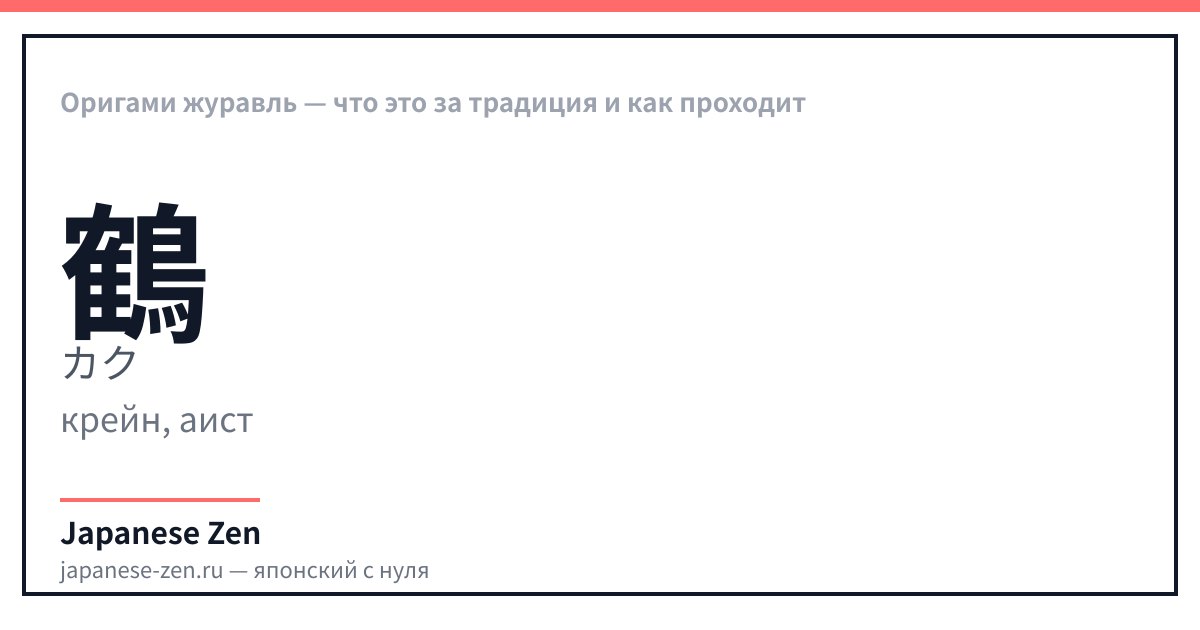
鶴 — значение: crane, stork — онъёми: カク — кунъёми: つる — 21 штрих(ов). 鶴 — 'crane': the second character in 折り鶴. In Japan, the bird is traditionally associated with longevity, so it is depicted on wedding and anniversary gifts separately from origami.
| Japanese | Reading | Translation |
|---|---|---|
| 折り鶴 | orizuru · orizuru | Origami crane |
| 折る | oru · oru | To fold, to bend |
| 鶴 | tsuru · tsuru | Crane |
| 紙 | kami · kami | Paper |
| 願い | negai · negai | Wish, desire |
折り鶴 — folded crane
折り鶴 is composed of 折る 'to fold, to bend' and 鶴 'crane' — 'folded crane', without metaphors. Senbazuru (千羽鶴) adds 千羽 'a thousand birds': it is precisely a thousand cranes, not a thousand abstract objects.
Listen to the words 折り鶴 and 願い and repeat — the app will evaluate your pronunciation.
Origami crane in anime
- A scene of folding a thousand cranes in a hospital room is a frequent dramatic device in anime and dramas about illness or war.
- The crane as a symbolic gift between characters — a way to show care without words.
- Origami as a character's hobby sometimes becomes a separate plot detail, and the crane is the most recognizable example.
- In anime about traditional Japan, cranes are sometimes hung in shrines as a collective wish, part of a broader tradition of offerings.
Paper crane and real crane
The origami crane is confused with the real bird — the crane — which people see in nature much less often than its paper image. The symbolism of longevity refers to the living bird; origami merely depicts it.
FAQ
- What is an origami crane?
- A classic figure made from a single square sheet of paper without scissors and glue — a series of folds turns the square into a bird with spread wings. One of the first origami skills that children learn at an early age.
- When is an origami crane folded?
- At any time — it is not a seasonal ritual, but a basic skill. A special occasion is the bundle of a thousand pieces: senbazuru is given as a wish for recovery or peace.
- How many steps are in the origami crane diagram?
- Six to eight folds from the base square: first the diagonals and midlines, then bringing the corners to the center, then pulling out the head, tail, and spreading the wings. The whole process takes a couple of minutes.
- How do you write 'origami crane' in Japanese?
- It is written 折り鶴, read 'orizuru': 折る 'to fold' plus 鶴 'crane' — literally 'folded crane'. The bundle of a thousand figures is called by a separate word — 千羽鶴, senbazuru.
- Is it difficult to fold a crane yourself?
- No, the diagram is easy to learn in one lesson; paper and instructions are sold in any stationery and souvenir store. Many museums and cultural centers hold short workshops.
- Why does the crane appear in illness scenes?
- Folding a thousand cranes in a hospital room is a frequent dramatic device in stories about illness. The crane also appears as a symbolic gift between characters without a single word.
Sources
Updated: 2026-08-29