Funny Japanese Phrases: 16 Expressions That Make You Smile
Funny Japanese phrases are often literal images: 猫の手も借りたい (neko no te mo karitai) "I want to borrow even a cat's paw" about being swamped, 猫舌 (nekojita) "cat tongue" about someone who can't eat hot food, 花より団子 (hana yori dango) "dango is more important than flowers" about practicality.
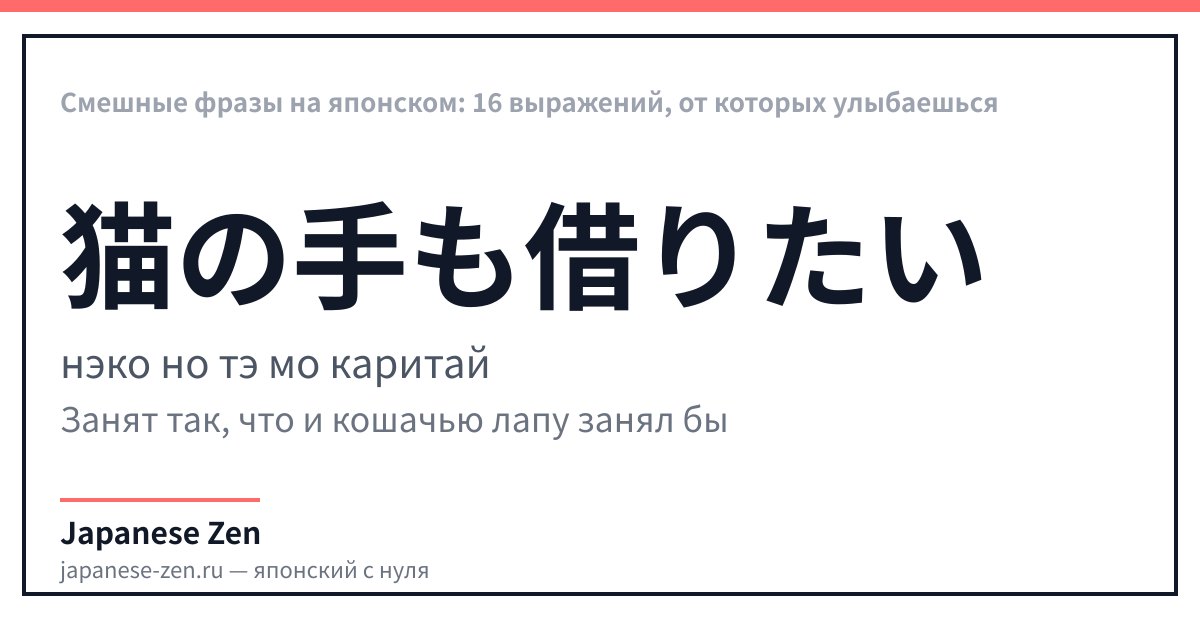
Japanese humor in idioms is literal: if a person can't eat hot food, they have a cat tongue. If there's a lot to do, you need to borrow a cat's paw. Cats work the hardest in this language.
Idioms That Sound Funny in Translation
| Japanese | Reading | Translation |
|---|---|---|
| 猫の手も借りたい | neko no te mo karitai · neko no te mo karitai | So busy I'd borrow a cat's paw |
| 猫舌 | nekojita · nekojita | "Cat tongue" — can't handle hot food |
| 花より団子 | hana yori dango · hana yori dango | Dango over flowers — practicality over beauty |
| 馬の耳に念仏 | uma no mimi ni nenbutsu · uma no mimi ni nenbutsu | A prayer in a horse's ear — like talking to a wall |
| 猿も木から落ちる | saru mo ki kara ochiru · saru mo ki kara ochiru | Even monkeys fall from trees |
| 腹が立つ | hara ga tatsu · hara ga tatsu | "The belly stands up" — to get angry |
| 目から鱗 | me kara uroko · me kara uroko | "Scales from the eyes" — to suddenly understand |
Why anger lives in the belly
Japanese places feelings in the body literally: 腹が立つ — "the belly stands up" (to get angry), 腹が黒い — "black belly" (treacherous), 腹を割る — "to split the belly" (to speak frankly). The belly 腹 in this worldview is the seat of true intentions, not emotions in general.
Words That Sound Funny to a Russian Ear
| Japanese | Reading | Translation |
|---|---|---|
| ちんぷんかんぷん | chinpunkanpun · chinpunkanpun | Complete gibberish, nothing is clear |
| どきどき | dokidoki · dokidoki | Heart pounding |
| ぺらぺら | perapera · perapera | Fluent (about language proficiency) |
| めちゃくちゃ | mechakucha · mechakucha | Total mess; very (intensifier) |
| はらはら | harahara · harahara | Anxiously, with a sinking heart |
"Perapera" is a compliment, not a mockery
If someone says 日本語がぺらぺらですね about your Japanese, it's a compliment: "you speak fluently." It sounds unserious, but the word is neutral and common. Japanese onomatopoeia is not considered baby talk at all — adults use it in everyday conversation.
Try a Tongue Twister
Try ちんぷんかんぷん — six syllables in a row without stumbling.
FAQ
- What are some funny phrases in Japanese?
- 猫の手も借りたい "I'd borrow a cat's paw", 猫舌 "cat tongue" (can't eat hot food), 馬の耳に念仏 "a prayer in a horse's ear", 花より団子 "dango over flowers".
- What does "chinpunkanpun" mean?
- ちんぷんかんぷん — "complete gibberish, I don't understand anything." The word sounds funny even to Japanese people, so it's often used jokingly.
- Why is anger connected to the belly in Japanese?
- 腹 "belly" in the Japanese worldview is the seat of true intentions: 腹が立つ "to get angry", 腹が黒い "treacherous", 腹を割る "to speak frankly".
- Is "perapera" offensive?
- No, it's a compliment: 日本語がぺらぺら means "you speak Japanese fluently." Japanese onomatopoeia is normal adult speech, not baby talk.
Updated: 2026-07-25