Popular Japanese Phrases: 20 Expressions You Hear Every Day
The most popular Japanese phrases in everyday speech: お疲れ様です (o-tsukaresama desu) 'you've worked hard', よろしくお願いします (yoroshiku onegai shimasu) 'please treat me favorably', 大丈夫です (daijōbu desu) 'it's fine', 失礼します (shitsurei shimasu) 'excuse me'. Their frequency is many times higher than textbook greetings.
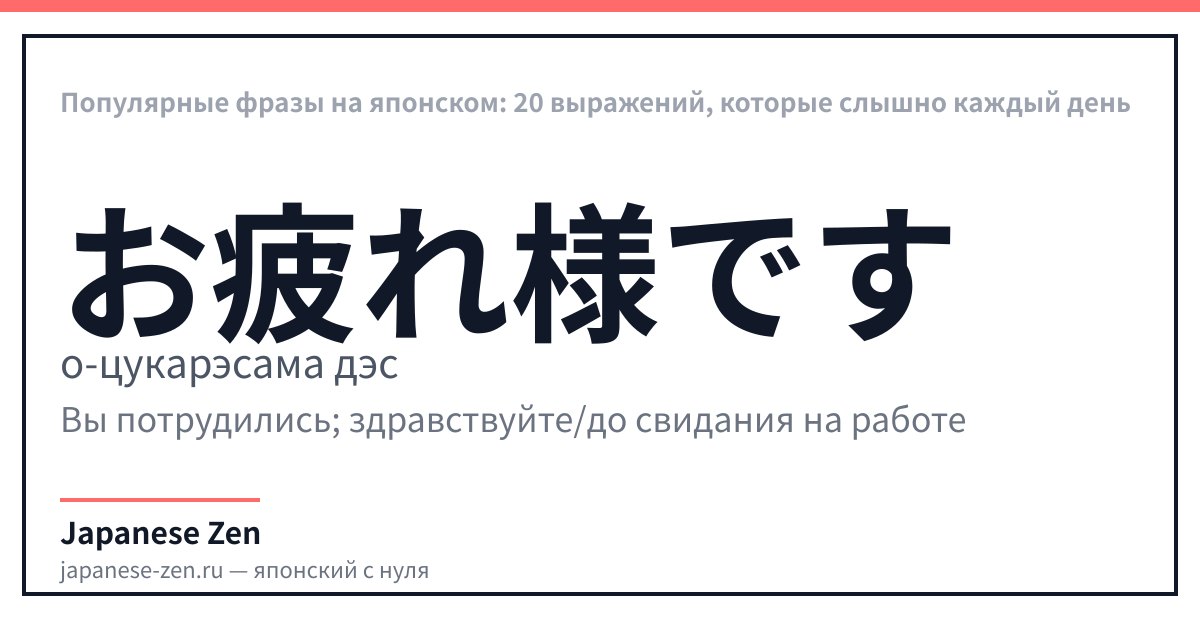
Textbooks teach こんにちは, but a Japanese person will say お疲れ様です twenty times a day. Below are phrases by real frequency, not in textbook order: the ones that lubricate all social gears and therefore sound continuously.
Phrases That Are Constantly Heard
| Japanese | Reading | Translation |
|---|---|---|
| お疲れ様です | o-tsukaresama desu · o-tsukaresama desu | You've worked hard; hello/goodbye at work |
| よろしくお願いします | yoroshiku onegai shimasu · yoroshiku onegai shimasu | Please treat me favorably |
| 大丈夫です | daijōbu desu · daijōbu desu | It's fine; no thank you |
| 失礼します | shitsurei shimasu · shitsurei shimasu | Excuse me (entering or leaving) |
| お世話になっております | o-sewa ni natte orimasu · o-sewa ni natte orimasu | Thank you for your continued support (opens almost any business letter) |
| そうですね | sō desu ne · sō desu ne | Yes, I suppose; indeed (universal reaction and pause for thought) |
| なるほど | naruhodo · naruhodo | I see, that's how it is |
Why お疲れ様です is more important than 'hello'
This phrase covers everything at once: greeting a colleague, acknowledging their work, saying goodbye at the end of the day, reacting to someone's fatigue. There is no direct translation — the closest is 'you've worked hard'. You'll hear it dozens of times during a shift at work, while こんにちは is hardly heard there.
Short Reactions in Conversation
| Japanese | Reading | Translation |
|---|---|---|
| えっと | etto · etto | Um, well... (pause filler) |
| ちょっと | chotto · chotto | A little; polite refusal |
| 本当に | hontō ni · hontō ni | Really? Seriously |
| すごい | sugoi · sugoi | Cool, wow |
| やっぱり | yappari · yappari | I knew it; after all |
| とりあえず | toriaezu · toriaezu | For now, to begin with |
'Chotto' — a way to say 'no' without saying 'no'
In response to a request, a Japanese person rarely gives a direct refusal. Instead, ちょっと… with a drawn-out intonation and a pause: literally 'a little…', meaning 'that would be difficult'. There will be no continuation, and that is a normal complete answer.
Say the Phrase Aloud
Start with 大丈夫です: dai-jō:-bu desu, with a long 'o' in the middle.
FAQ
- What are the most popular Japanese phrases?
- お疲れ様です (o-tsukaresama desu), よろしくお願いします (yoroshiku onegai shimasu), 大丈夫です (daijōbu desu), 失礼します (shitsurei shimasu), そうですね (sō desu ne).
- What does 'o-tsukaresama desu' mean?
- Literally 'you've worked hard'. It works as a greeting, acknowledgment of work, and farewell at work; there is no direct Russian equivalent.
- Why is 'chotto' a refusal?
- ちょっと with a drawn-out intonation means 'that would be difficult'. Japanese people avoid a direct 'no', so the phrase is cut off — and that is a complete answer.
- When do you say 'yoroshiku onegai shimasu'?
- When meeting someone, at the beginning of any joint endeavor, at the end of a business letter. The meaning is 'please treat me favorably and support me'.
Updated: 2026-07-25