How to Say Older Brother in Japanese: 兄 and お兄さん
Older brother in Japanese is 兄 (ani) when talking about your own brother to someone else, and お兄さん (onīsan) when addressing him or talking about someone else's brother. Affectionately, it's お兄ちゃん (onīchan). Younger brother is 弟 (otōto), a completely different word.
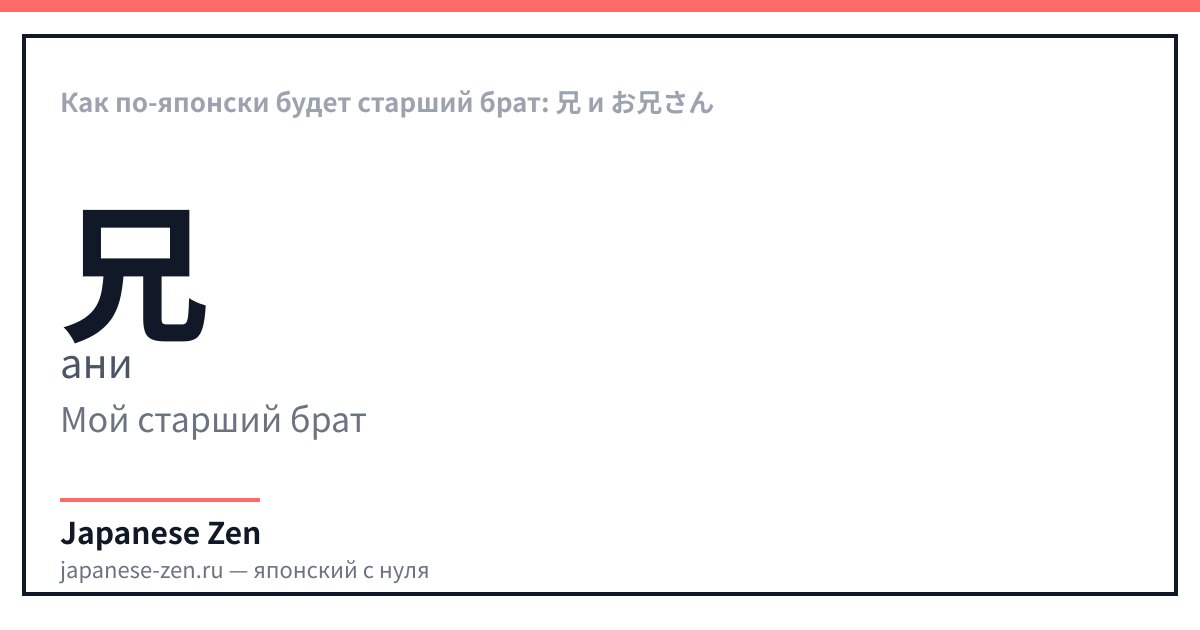
In Japanese, you can't just say 'brother': the language requires specifying whether he's older or younger, and whose brother he is — yours or the listener's. Because of this, one Russian word expands into four Japanese ones, and choosing between them is a choice of distance.
How to Say 'Older Brother' in Japanese
| Japanese | Reading | Translation |
|---|---|---|
| 兄 | ani · ani | My older brother (humbly, about one's own — to someone else) |
| お兄さん | onīsan · oniisan | Older brother (yours or in address) |
| お兄ちゃん | onīchan · oniichan | Big brother (affectionately, as younger sisters call him) |
| 弟 | otōto · otooto | Younger brother |
| 姉 | ane · ane | My older sister |
| 妹 | imōto · imooto | Younger sister |
| 兄弟 | kyōdai · kyoodai | Brothers and sisters in general |
Why You Speak Differently About Your Own Brother vs. Someone Else's
This is a basic rule of Japanese politeness: you humble what's yours and elevate what's others'. So to a stranger you'll say 兄 (ani) — 'my older brother', and about their brother — お兄さん. At home, however, you address your own brother as お兄ちゃん: inside the family a different logic applies, where closeness matters more than modesty.
'Onii-chan' from Anime
- お兄ちゃん — a younger sister's address to her brother; hence the word's popularity in anime.
- 兄貴 (aniki) — 'big bro', a rough but respectful term, typical of yakuza and male groups.
- お兄さん can also be said to an unfamiliar young man — like the Russian 'molodoy chelovek', but more often in shops and markets.
- Addressing an older brother by name in a traditional family is considered impolite: you're supposed to call him by his role.
Say the Words Aloud
In 'oniisan' the 'i' is long: o-nii-san, the sound stretches twice as long.
FAQ
- How do you say older brother in Japanese?
- 兄 (ani) — about your own brother to someone else, お兄さん (onīsan) — in address and about someone else's brother, お兄ちゃん (onīchan) — affectionately.
- And how do you say younger brother?
- 弟 (otōto). Japanese always distinguishes seniority: 兄 is older, 弟 is younger, and they are different words, not forms of the same one.
- Why do you speak differently about your own and someone else's brother?
- You humble what's yours and elevate what's others' — a basic rule of politeness. Hence the pairs: 兄 / お兄さん, 姉 / お姉さん, 母 / お母さん.
- What does 'aniki' mean?
- 兄貴 — 'big bro': a rough but respectful address to an older comrade, typical of male groups and crime stories.
Updated: 2026-07-25