Susanoo — who is he in Japanese mythology
Susanoo is the god of storms and the sea, the younger brother of Amaterasu, exiled from the heavens for his violent temper. He atoned for his guilt on earth: he killed the eight-headed serpent Yamata-no-Orochi and saved the maiden Kushinada-hime. In the serpent's tail was found the sword Kusanagi — one of the three sacred imperial regalia — and Susanoo gave it to his sister.
Susanoo has a biography rare for a god: first he throws a tantrum, wrecks his sister's rice fields, and gets exiled, then he goes off to kill a monster and becomes a hero. Few deities go from troublemaker to savior in a single scroll.
Who is Susanoo and why was he exiled
Susanoo-no-mikoto is the god of storms and the sea, the youngest of the three children born to Izanagi during his purification after returning from the land of the dead: he appeared when his father washed his nose. He was given dominion over the sea, but Susanoo spent his childhood longing for his deceased mother Izanami and yearning to follow her to Yomi — his weeping dried up rivers and withered trees.
- Sphere of influence: storm, sea, and later the fertile Izumo valley.
- Symbol: the sword Kusanagi, found in the tail of the slain serpent.
- Lineage: son of Izanagi, younger brother of Amaterasu (sun) and Tsukuyomi (moon).
- Fate: exiled from the heavens, became the earthly ruler of Izumo.
How much space the chronicles devoted to him
Susanoo's story takes up more space in the chronicles than the myth of any other god except Amaterasu: the tale of the serpent Yamata-no-Orochi in the Kojiki (712 AD) is told in detail, with direct speech and a description of the sake trap. The Nihon Shoki (720 AD) adds a variant where Susanoo first descends not to Izumo but to Korea — a detail usually omitted in retellings.
The eight-headed serpent and the sword found in its tail
Before leaving for Yomi to see his mother, Susanoo decided to say goodbye to Amaterasu — she feared an invasion and came out to meet him fully armed. To prove his peaceful intentions, the gods held a ritual contest of ukei: each produced children from the other's belongings. Susanoo declared himself the winner and, emboldened, went on a rampage in her domain — he destroyed the boundaries of the rice fields, defiled the harvest hall, and finally threw a flayed horse into the weavers' workshop, killing a servant. Enraged and frightened, Amaterasu hid in a cave, plunging the world into darkness — and Susanoo was exiled from the heavens. Descending to the land of Izumo, he met an old man and an old woman mourning their daughter: the eight-headed serpent Yamata-no-Orochi had already devoured seven of their daughters and was coming for the last one, Kushinada-hime. Susanoo turned the girl into a comb, hid her in his hair, set out eight vats of strong sake — the serpent drank it all, became drunk, and fell asleep. While the monster slept, Susanoo cut off all eight heads and tails, and in one of the tails he found a sword, which he named Kusanagi ('grass-cutter') and sent to his sister as a sign of reconciliation.
Not just a dragon slayer
In games and anime, Susanoo is almost always just a 'dragon slayer.' The chronicle, however, does not end with him as a hero: after his victory, he builds a palace in Suga and, according to legend, composes the first waka poem in Japanese poetry. This peaceful ending is usually cut entirely by popular culture.
須佐之男 and 素戔嗚 — two ways to write the name
| Japanese | Reading | Translation |
|---|---|---|
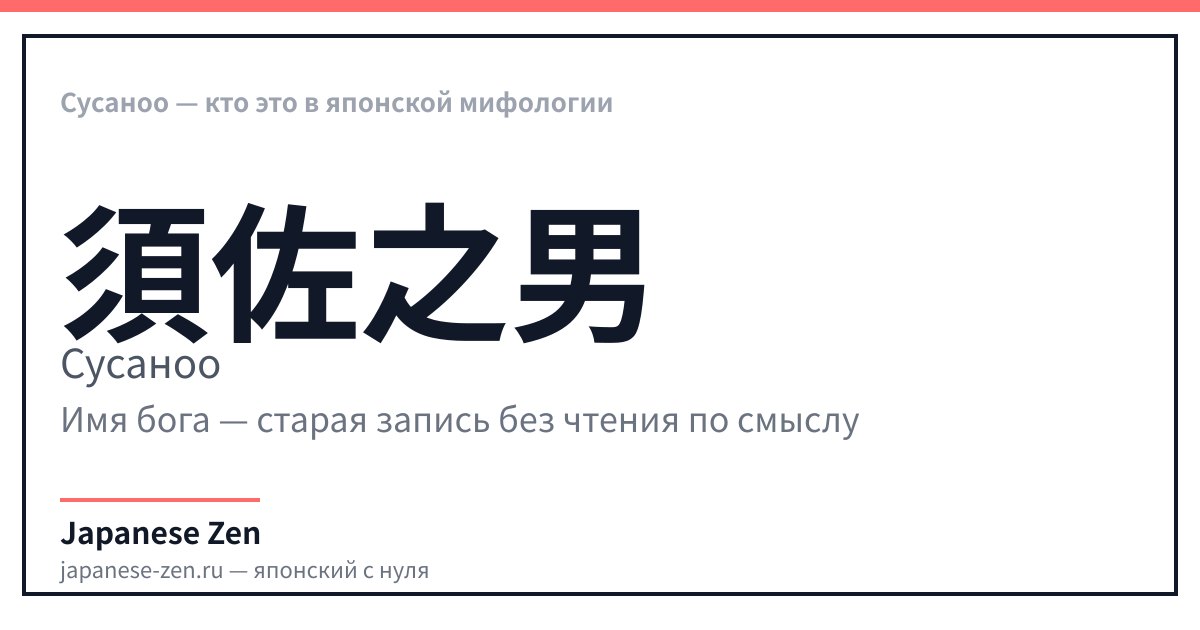
| 須佐之男 | Susanoo · Susanoo | The god's name — an old writing without meaning-based reading |
| 素戔嗚 | Susanoo · Susanoo | Alternative writing of the name from the Nihon Shoki |
| 八岐大蛇 | Yamata-no-Orochi · Yamata-no-Orochi | The eight-headed serpent from the main myth |
| 草薙剣 | Kusanagi no Tsurugi · Kusanagi no Tsurugi | The sword found in the serpent's tail |
| 嵐 | arashi · arashi | Storm |
Why there are several ways to write the name
Susanoo's name is written in the chronicles with at least two different sets of characters — 須佐之男 in the Kojiki and 素戔嗚 in the Nihon Shoki — with the same reading すさのお. This is a phonetic transcription without regard to the meaning of the characters (manyogana): the chroniclers simply chose kanji to match the syllables, so one name could be written differently in different sources.
男 — значение: male — онъёми: ダン、ナン — кунъёми: おとこ、お — 7 штрих(ов). 男 — 'man, son': on top is the field 田, below is strength 力 — literally 'strength in the field.' The last syllable of Susanoo's name.
Write 男 along the guides — a basic N5-level kanji.
Susanoo in Naruto and Smite
- Naruto — 'Susanoo' here is the name of a giant spirit warrior summoned by Itachi, Sasuke, and Madara: the complete opposite of the myth, where Susanoo himself was never a giant warrior.
- Smite — Susanoo is one of the playable gods in this team-based MOBA, with sword strikes and storm-themed abilities.
- Nobunaga no Chef and similar historical fantasy — often introduce him as the guardian spirit of the Izumo region.
- Many role-playing games use the name Susanoo for weapons or bosses associated with storms.
Why his name is given to combat techniques
Susanoo is one of the few gods in the pantheon with a solid combat reputation: he personally killed a monster with his bare hands (or rather, with a sword and cunning). For a writer, this is a ready-made 'war god' archetype that doesn't need to be explained from scratch.
Where Susanoo is worshipped
- Yasaka Shrine in Kyoto — a major Susanoo shrine that hosts the Gion Matsuri festival, one of Japan's three major festivals.
- Kumano Taisha in Izumo — the region where the battle with the serpent is said to have taken place.
- Hikawa Shrine in Saitama — one of the oldest shrines dedicated to Susanoo.
- The Gion Matsuri festival in July — originally conceived as a ritual to appease Susanoo during epidemics.
FAQ
- Who is Susanoo in Shinto?
- The god of storms and the sea, the younger brother of Amaterasu, exiled from the heavens for the destruction he caused in her domain. On earth, he atoned for his guilt by killing the serpent Yamata-no-Orochi and founding the lineage of the rulers of Izumo.
- What is Susanoo the god of?
- Originally the sea, but in myths he is better known as a subduer of storms and a vanquisher of monsters. After his feat with the serpent, he became associated with earthly power and protection from epidemics.
- Why is Susanoo's name written differently?
- There are at least two variants: 須佐之男 in the Kojiki and 素戔嗚 in the Nihon Shoki, both read as すさのお. The characters are chosen phonetically, without regard to meaning — a common practice in 8th-century Japanese chronicles.
- Where does the name Susanoo appear in anime and games?
- Most often as the name of an ability, not a character: in Naruto, it refers to a giant spirit warrior of the Uchiha clan. Direct narrative retellings of the myth in popular titles are rare.
- Where in Japan is Susanoo worshipped?
- The largest shrine is Yasaka Shrine in Kyoto, famous for the Gion Matsuri festival. He is also worshipped in Izumo, where, according to legend, the whole story with the serpent begins.
- Is Susanoo a god or a spirit?
- A kami, one of the principal gods of the Shinto pantheon — son of Izanagi and full brother of Amaterasu. In power and status, he stands on par with the greatest deities, not among lower-ranking spirits.
Sources
Updated: 2026-08-29