Japanese Quotes with Translation: 16 Phrases and Their Origins
Japanese quotes with translation are most often taken from proverbs and Zen texts: 七転び八起き (nanakorobi yaoki) "fall seven times, stand up eight", 初心忘るべからず (shoshin wasuru bekarazu) "don't forget where you started", 明日は明日の風が吹く "tomorrow the wind will blow tomorrow's wind". Below are 16 phrases with a reading in Russian letters and the source indicated.
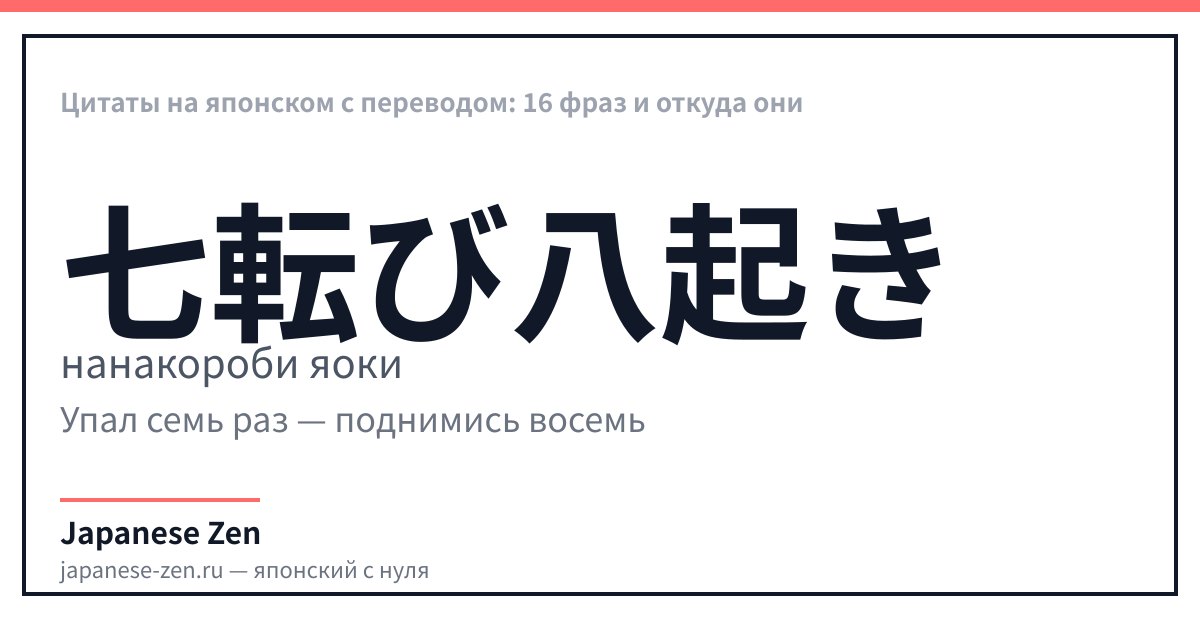
Half of the "Japanese quotes" on the internet were never spoken by Japanese people: they were written in English and translated back. Below are those that have a real source: a proverb, a Zen text, or a treatise on the warrior's path.
Proverbs that Japanese people actually say
| Japanese | Reading | Translation |
|---|---|---|
| 七転び八起き | nanakorobi yaoki · nanakorobi yaoki | Fall seven times, stand up eight |
| 石の上にも三年 | ishi no ue ni mo sannen · ishi no ue ni mo sannen | Even a stone will warm up if you sit on it for three years |
| 明日は明日の風が吹く | ashita wa ashita no kaze ga fuku · ashita wa ashita no kaze ga fuku | Tomorrow the wind will blow tomorrow's wind |
| 猿も木から落ちる | saru mo ki kara ochiru · saru mo ki kara ochiru | Even a monkey falls from a tree |
| 十人十色 | jūnin toiro · juunin toiro | Ten people, ten colors |
| 出る杭は打たれる | deru kui wa utareru · deru kui wa utareru | The nail that sticks out gets hammered down |
Why "the nail that sticks out" is not about conformism
出る杭は打たれる is often quoted as a verdict on Japanese society. In Japan itself, the proverb has a continuation in the saying tradition: 出過ぎた杭は打たれない — "the nail that sticks out too far cannot be hammered down." The meaning changes to the opposite: if you stand out, do it seriously.
From Zen and treatises
| Japanese | Reading | Translation |
|---|---|---|
| 初心忘るべからず | shoshin wasuru bekarazu · shoshin wasuru bekarazu | Do not forget your original intention (Zeami, treatise on Noh theater, 15th century) |
| 一期一会 | ichigo ichie · ichigo ichie | This encounter is unique and will never repeat (tea ceremony, Sen no Rikyū) |
| 和敬清寂 | wa kei sei jaku · wa kei sei jaku | Harmony, respect, purity, tranquility (four principles of the tea ceremony) |
| 日々是好日 | nichinichi kore kōjitsu · nichinichi kore koujitsu | Each day is a good day (Zen saying) |
| 諸行無常 | shogyō mujō · shogyou mujou | All things are impermanent (Buddhist formula, opens "The Tale of the Heike") |
How to distinguish a real quote from a fabricated one
- A real quote has a Japanese original, not just a translation: if you can't find the characters, the quote doesn't exist.
- Check whether the phrase appears in the Japanese internet — not in "japanese quotes" collections, but on Japanese websites.
- Attribution to samurai and "ancient wisdom" without an author's name is almost always a sign of fabrication.
- Too smooth aphoristic quality in Russian is also suspicious: Japanese proverbs are usually concrete and down-to-earth.
Say the quote aloud
Start with 一期一会 — four even syllable pairs.
FAQ
- What are some beautiful Japanese quotes with translation?
- 七転び八起き "fall seven times, stand up eight", 初心忘るべからず "don't forget where you started", 日々是好日 "each day is a good day", 一期一会 "this encounter is unique".
- Where do Japanese quotes come from?
- From proverbs, Zen sayings, treatises on theater and the tea ceremony. Many "Japanese quotes" from the internet are written in English and have no original.
- How to check if a quote is real?
- Find the Japanese original in characters and check if it appears on Japanese websites. The absence of an original is a sure sign of fabrication.
- Which quotes are suitable for tattoos?
- Short and complete ones: 一期一会, 初心, 七転び八起き, 日々是好日. Long proverbs with particles look better on paper than on skin.
Updated: 2026-07-25