Tsukuyomi — who is he in Japanese mythology
Tsukuyomi is the moon god, the middle of the three main children of Izanagi, born from his right eye. Unlike his sister Amaterasu and brother Susanoo, he has almost no myths of his own: only one story survives — how he killed the food goddess Ukemochi for preparing food from her mouth. Since then, the Sun and Moon do not appear in the sky together.
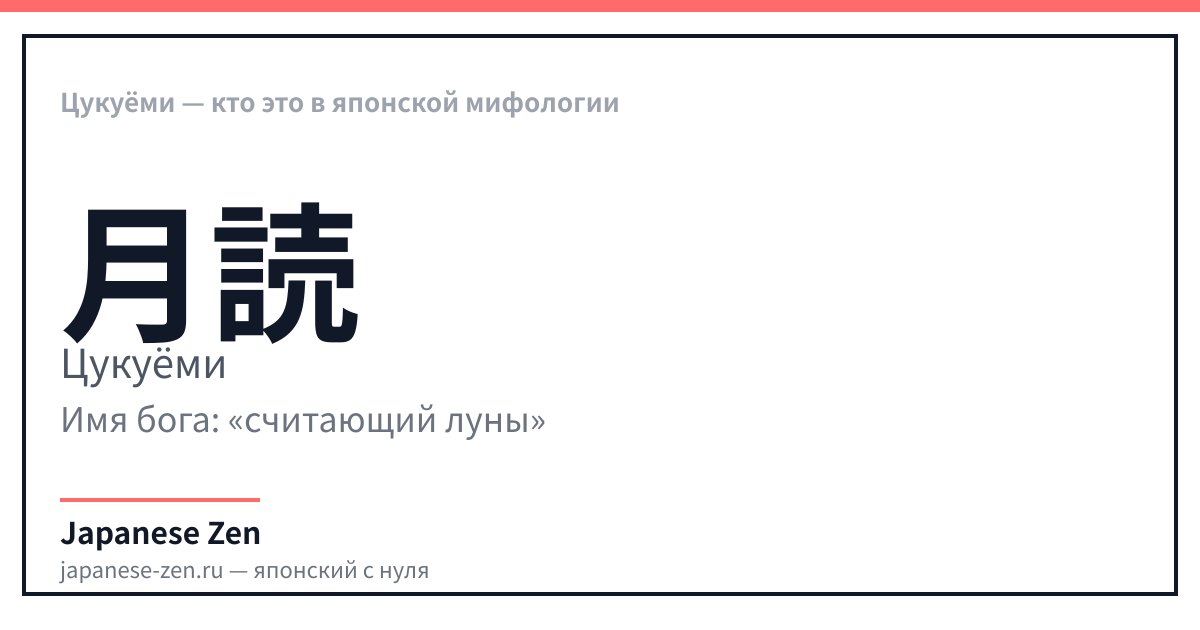
Tsukuyomi is the god about whom Japanese mythology tells the least, and that's the point: his absence from the chronicles' plot itself became a plot — a folkloric explanation of why day and night never meet.
Who is Tsukuyomi and why so little is known about him
Tsukuyomi-no-mikoto is the god of the moon and night, the middle of the three children born from Izanagi during his purification after Yomi: Amaterasu appeared from his left eye, Tsukuyomi from his right, and Susanoo from his nose. The father appointed him to rule the night sky, just as Amaterasu received the day. And that, in most retellings, is where the substantive part of his biography ends.
- Sphere of influence: the moon, night, timekeeping by the lunar calendar.
- Symbol: Tsukuyomi has no attribute of his own — neither a mirror like his sister, nor a sword like his brother.
- Lineage: son of Izanagi, the middle of the three main children.
- Distinctive feature: the most inconspicuous god of the triad — mentioned almost exclusively in connection with his birth.
Why the two chronicles diverge precisely here
The difference between the sources is especially telling here: the Kojiki (712 AD) mentions Tsukuyomi only at birth and almost immediately forgets about him. The story of killing the food goddess appears only in the Nihon Shoki (720 AD) — and not in all versions of the myth; in some variants, Susanoo himself plays this role instead of Tsukuyomi.
Why he killed the food goddess
Amaterasu sent her younger brother Tsukuyomi to earth to visit the food goddess Ukemochi-no-kami and pay her respects. The goddess decided to hold a feast and began to produce the treats directly from her own body: rice from her mouth, fish from the sea through her anus, game from her nose. Seeing this, Tsukuyomi was enraged by such 'unclean' presentation of food and cut the goddess down with his sword on the spot. When he returned and reported what had happened, Amaterasu was so horrified and angry that she declared she no longer wished to see him — and from that day on, she began to hide from her brother, appearing in the sky only when he was not there. Thus — according to this version of the myth — day and night were forever separated into different parts of the day.
Where the image of the sinister night god came from
In popular culture, Tsukuyomi almost always appears as a mysterious, sinister deity of the night — but this is more of an embellishment than a direct following of the source: the chronicle describes his act as intemperance and cruelty, not as a dark nature. He is not a villain, but simply a character who barely gets any lines in the plot.
月読 — 'counting the moons'
| Japanese | Reading | Translation |
|---|---|---|
| 月読 | Tsukuyomi · Tsukuyomi | God's name: 'counting the moons' |
| 月 | tsuki · tsuki | Moon, month |
| 読む | yomu · yomu | To read, to count |
| 夜 | yoru · yoru | Night |
| 太陰暦 | taiinreki · taiinreki | Lunar calendar |
Tsukuyomi, Tsukiyomi and other variants
月読 is read つくよみ (Tsukuyomi): 月 'moon' plus 読む 'to count, to keep count' — literally 'one who counts the phases of the moon', a reference to the moon's role in the ancient calendar. In the Nihon Shoki, variants 月夜見 and 月弓 appear, where the second characters shift the nuance from 'counting' to 'contemplating the night' or 'bow', but the reading remains the same.
月 — значение: month, moon — онъёми: ゲツ、ガツ — кунъёми: つき — 4 штрих(ов). 月 — 'moon, month': a pictograph of a crescent moon. The same character appears in 月曜日 (Monday) and dozens of words about time.
Write 月 along the guides — one of the first kanji at the N5 level.
Tsukuyomi in Naruto and Persona 3
- Naruto — 'Tsukuyomi' here is the name of Itachi's illusion technique that plunges the victim into a nightmare where time flows differently: an obvious reference to the night god, not to his myth.
- Persona 3 — Tsukuyomi appears as one of the key Personas of the protagonist.
- Fate/Grand Order — appears among the guardian spirits in the Japanese arc.
- Many role-playing games and mobile gachas use his name for 'lunar' or 'shadow' units.
Why the emptiness in the myth is convenient for authors
The scarcity of myths about Tsukuyomi paradoxically works in his favor: since the chronicle left no clear image, authors are free to invent any — mysterious, sinister, melancholic. The blank space in the source becomes creative freedom.
Where the moon god is worshipped
- Tsukiyomi-jinja in Ise — a branch of the Ise Jingu complex dedicated personally to him, standing next to the shrine of Amaterasu.
- Matsunoo Taisha in Kyoto — among other deities, venerates Tsukuyomi as one of the shrine's gods.
- The moon-viewing festival tsukimi (月見) in September — formally dedicated not directly to the god, but to the moon itself as a phenomenon.
- Small rural shrines with the prefix 'Tsukiyomi' are scattered throughout the country, but mostly without major cult significance.
FAQ
- Who is Tsukuyomi in Shinto?
- The god of the moon and night, the middle of the three children of Izanagi, born from his right eye. Unlike his sister Amaterasu and brother Susanoo, very few independent myths about him have survived.
- What is Tsukuyomi responsible for?
- For the moon, night, and timekeeping by lunar phases — the name itself translates as 'counting the moons'. According to one myth, because of his hot temper, the sun and moon stopped appearing in the sky together.
- What do the characters 月読 mean?
- 月読 (つくよみ): 月 'moon' plus 読む 'to count'. In the Nihon Shoki, variants 月夜見 and 月弓 appear with the same reading but a different nuance.
- Where is the name Tsukuyomi used in anime and games?
- Most often as the name of an ability — for example, Itachi's hypnotic technique in Naruto. As a character under his own name, the god appears in games like Persona 3 and Fate/Grand Order.
- Where in Japan is Tsukuyomi worshipped?
- A separate shrine, Tsukiyomi-jinja, stands next to the main Ise Jingu complex. He is also venerated at Matsunoo Taisha in Kyoto and in scattered rural shrines across the country.
- Is Tsukuyomi a god or a spirit?
- A kami, one of the three main children of Izanagi, on par with Amaterasu and Susanoo. Despite the scarcity of myths, by formal status he stands at the very top of the pantheon.
Sources
Updated: 2026-08-29