Tsuchinoko — the Japanese cryptid: the fat snake with a bounty on its head
The tsuchinoko is a Japanese cryptid: a short, thick snake, bulging in the middle, resembling the head of a wooden mallet without a handle. It is said to jump like a kangaroo, roll down hills like a wheel, and enjoy sake. Sightings have been collected since the 1970s, and the village of Higashi-Shirakawa in Gifu offers over a million yen for a live tsuchinoko — but no one has ever caught one.
The tsuchinoko is a rare case where a cryptid is officially hunted not by lone enthusiasts but by entire villages with a cash prize. Let's explore where the name "mallet's child" came from, how a 1970s manga turned a local tale into a nationwide craze, what the elusive snake is most often mistaken for, and what a cult video game about Snake has to do with it.
Tsuchinoko: the fat snake from the old Japanese mountains
According to eyewitness accounts, the tsuchinoko is a short snake up to half a meter long, noticeably swollen in the middle and almost the same thickness at the head and tail, resembling the head of a wooden mallet without a handle. It is credited with unusual habits: it jumps like a kangaroo, can roll down a hill like a wheel, and is rumored to be fond of sake. The old name for this creature is nozuchi (野槌). In the 1712 encyclopedia Wakan Sansai Zue, it is described as a snake living in remote mountains, with a large mouth, biting people's legs. Such a creature is said to run very fast downhill, but noticeably slower uphill, so one can escape by climbing higher.
Why tsuchinoko means "mallet's child"
The name itself is a direct comparison with a tool: 槌 "mallet, hammer" plus の子 "child, offspring". The older nozuchi adds 野 "field, wilderness" in front — literally "field mallet". Both names describe the same thing: a thick, legless body without a distinct neck, as if the handle had fallen off a wooden mallet.
The 1970s boom: the manga that made the whole country search for the tsuchinoko
The nationwide craze for hunting the tsuchinoko was sparked by the manga "Phantom Snake Bachiebi", released in 1973 by Yaguchi Takao — who said he himself once encountered the creature in the mountains. In 1974, the manga, along with his other series "Crazy Fisherman Sampei", won the fifth Kodansha Award in the children's manga category, and the word "tsuchinoko" firmly entered everyday use.
The prize that no one has claimed yet
In the village of Higashi-Shirakawa in Gifu Prefecture, a spring festival with a cash prize for a live tsuchinoko has been held for over thirty years. At the 32nd festival in 2024, the sum grew to 1.32 million yen and increases by 10,000 yen for each year without a catch — and it has never been caught. Finds are reported from time to time, but upon inspection they always turn out to be something else.
Tsuchinoko in the Snake game and what it is mistaken for
In the game Metal Gear Solid 3: Snake Eater (2004, Konami), the tsuchinoko is a rare animal that can be caught with a mousetrap and added to your collection. The game does not explain any direct connection to folklore — here the tsuchinoko is just a rare, funny trophy.
What the tsuchinoko is most often mistaken for
The tsuchinoko is most often mistaken for escaped blue-tongued skinks: their short legs and thick body make their silhouette from above resemble the cryptid's description. Another common source of rumors is an ordinary snake that has recently swallowed large prey: its belly swells, and the silhouette resembles a fat tsuchinoko. In July 2022, in the city of Miki, Hyogo Prefecture, a find resembling a tsuchinoko was identified by experts at the Museum of Nature and Human Activities as a hawk moth caterpillar, whose scaly pattern and eye spots mimic a snake to scare off birds.
幻 — the sign of "phantom" given to the katakana snake
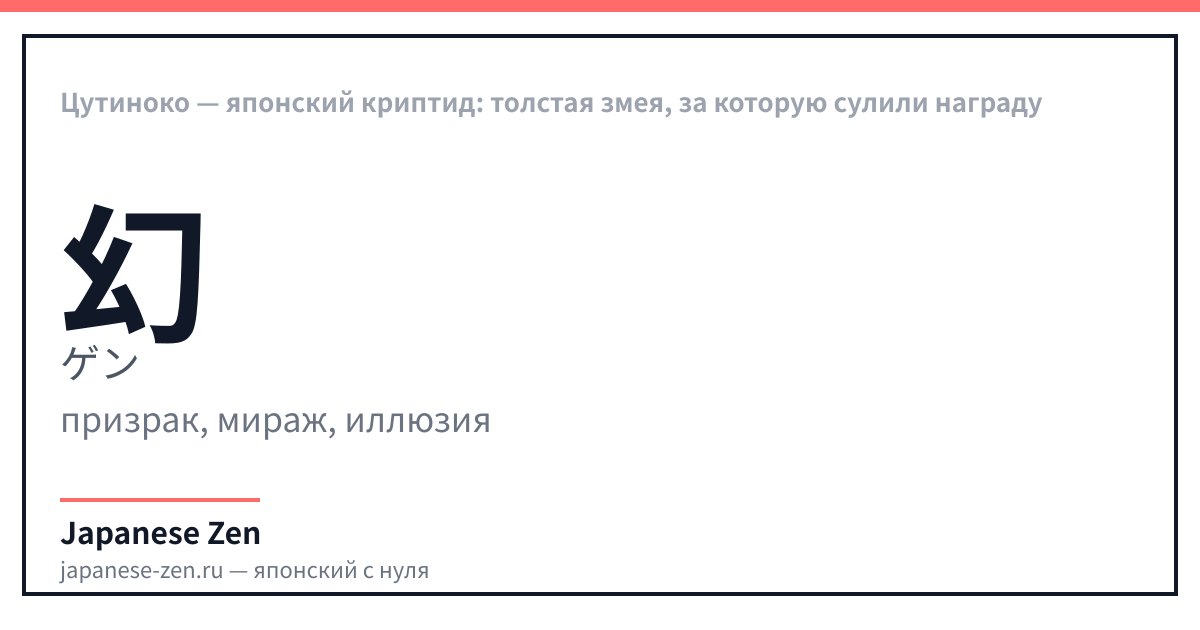
幻 — значение: phantom, mirage, illusion — онъёми: ゲン — кунъёми: まぼろし — 4 штрих(ов). 幻 — "phantom, mirage, illusion": the word 幻の〜 "elusive, legendary" describes the tsuchinoko in Japanese texts more accurately than any other.
In kanji, tsuchinoko can be written as 槌の子, "mallet's child", but in practice the name is almost always written in katakana: ツチノコ. The key character for this topic is 幻: the creature itself is called "幻の生物" — "elusive, phantom creature" — in Japanese sources, and the same word appeared in the title of the manga that launched the 1970s boom — "幻の怪蛇バチヘビ", "Phantom Snake Bachiebi". Separately, 幻 is read ゲン in Sino-Japanese words and まぼろし as a standalone word.
Why "phantom" appears so often in cryptid headlines
The combination 幻の〜 has long been a standard formula for anything elusive and almost legendary. The tsuchinoko is a perfect example: officially no one has caught it, yet talk about it has not stopped for decades. The abbreviation UMA (未確認動物, "unidentified mysterious animal") was also coined in Japan: it was proposed in 1976 for a book about mysterious animals, modeled after the English abbreviation UFO.
| Japanese | Reading | Translation |
|---|---|---|
| ツチノコ | tsuchinoko · tsuchinoko | A cryptid snake from the Japanese mountains |
| 槌の子 | tsuchinoko · tsuchinoko | The same name written in kanji |
| 野槌 | nozuchi · nozuchi | The old name of the tsuchinoko in mountain legends |
| 未確認動物 | mikakunin dōbutsu · mikakunin dōbutsu | Unidentified animal — the term that gave rise to UMA |
| 幻 | maboroshi · maboroshi | Phantom, illusion, something elusive |
| 正体 | shōtai · shōtai | True nature; what the creature actually turns out to be |
Write 幻 along the guides — the sign of "phantom", which in Japan is used to name the elusive snake.
FAQ
- What is a tsuchinoko?
- The tsuchinoko is a Japanese cryptid, a thick short snake up to half a meter long, talked about for centuries. The old name of the creature is nozuchi, and the current "tsuchinoko", "mallet's child", was given to it for its resemblance to the head of a wooden mallet without a handle.
- What does the tsuchinoko look like according to stories?
- According to eyewitness descriptions, the tsuchinoko's body is short and noticeably swollen in the middle, with the head and tail almost the same thickness. It is credited with jumping like a kangaroo, rolling down slopes like a wheel, and, rumored, a love of sake, though none of these traits has been confirmed.
- Is it true that a reward was offered for catching a tsuchinoko?
- Yes, in the village of Higashi-Shirakawa in Gifu Prefecture, a festival with a prize for a live tsuchinoko has been held for over thirty years. In 2024, at the 32nd festival, the sum grew to 1.32 million yen and increases by 10,000 yen for each year without a winner. So far no one has claimed the prize.
- Does the tsuchinoko really exist?
- Science has not confirmed the existence of the tsuchinoko — reports of encounters remain eyewitness accounts, not verified finds. The tsuchinoko is most often mistaken for escaped blue-tongued skinks or ordinary snakes with bellies swollen from prey; in 2022 in the city of Miki, a hawk moth caterpillar was even mistaken for one.
- Where does the tsuchinoko appear in games and manga?
- In the video game Metal Gear Solid 3: Snake Eater (2004), the tsuchinoko is a rare animal that can be caught with a mousetrap and kept. And Yaguchi Takao's 1973 manga "Phantom Snake Bachiebi" sparked the nationwide tsuchinoko hunting boom in the 1970s.
- How is "tsuchinoko" written in Japanese?
- 槌の子, read つちのこ, but almost always written in katakana — ツチノコ. Literally the name means "mallet's child": 槌 "mallet, hammer" plus の子 "child". The older name, nozuchi (野槌), adds 野 "field, wilderness" in front.
Sources
Updated: 2026-09-15