What does the phrase “yamete kudasai” mean
What does the phrase “yamete kudasai” (やめてください) mean — “please stop”, a polite request to stop an action. The base is the verb 止める (yameru, “to stop”) in the te-form plus ください, “please”. The short やめて (yamete) is the same but informal, while the harsh やめろ (yamero) is a command “stop!”.
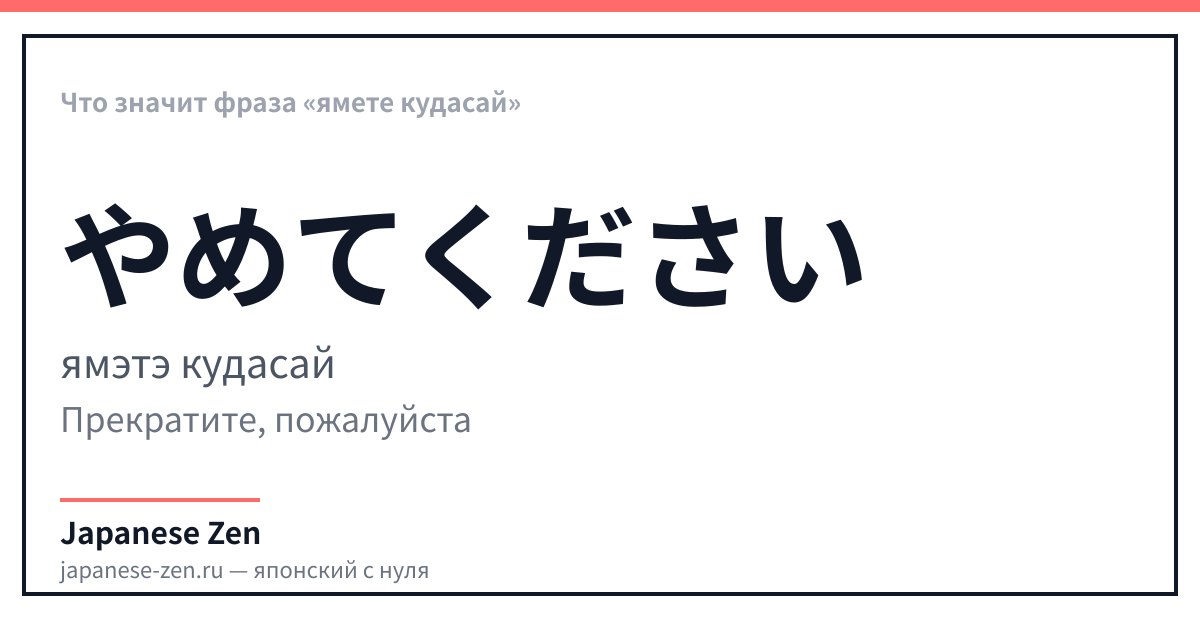
The phrase became a meme from a dubious context, but in Japanese it is a common request to stop: people use it to ask someone to turn down loud music, stop pushing on the train, or stop taking photos. Let’s break it down by parts and levels of politeness — this will also show how requests are generally built in Japanese.
What does “yamete kudasai” mean and how is the phrase structured
The te-form + ください construction is the basic way to politely ask for something. By changing the verb before ください, you get any request: 待ってください — “please wait”, 見てください — “please look”.
| Japanese | Reading | Translation |
|---|---|---|
| やめてください | yamete kudasai · yamete kudasai | Please stop |
| やめて | yamete · yamete | Stop (informal, between close people) |
| やめろ | yamero · yamero | Stop! (command) (harsh, rude; shouted in a fight) |
| 止める | yameru · yameru | To stop, to quit (an activity) (original verb) |
| おやめください | oyame kudasai · oyame kudasai | Please refrain (formal, in announcements and from staff) |
| 助けて | tasukete · tasukete | Help! (if the situation is truly dangerous, this is what you shout) |
Three levels of one request
やめろ is a command, appropriate only in danger or a quarrel. やめて is a request to a friend or close person. やめてください is neutral-polite, suitable for strangers. The longer the form, the more polite it is: this is a general rule of Japanese, not a peculiarity of this verb.
止 — значение: to stop, to cease, stop — онъёми: シ — кунъёми: と.まる、と.める、とど.める、とど.め — 4 штрих(ов). 止 — the kanji from this phrase, the same character appears on road signs 止まれ “stop”. Click “Show stroke order” to see how to write it.
Where you will hear the phrase and where you should not say it
- Someone is filming you — 撮影はやめてください, “please don’t film”.
- A neighbor is noisy at night — うるさいのでやめてください sounds polite but firm.
- People are pushing on the train — a short やめてください is appropriate and not considered rude.
- What not to do: don’t jokingly say the phrase to unfamiliar Japanese people — because of internet memes, it may be misunderstood.
- In real danger, you don’t shout やめて but 助けて (tasukete) — “help!”.
How to pronounce it
“Ya-me-te ku-da-sai”, all syllables are even and short. There is no stress in the Russian sense: not “yamEte”, but evenly. The vowel “u” in ください is almost swallowed — it sounds more like “kdasai”, and that is normal in fluent speech.
Say the request aloud — the app will compare it with the reference recording.
FAQ
- What does the phrase “yamete kudasai” mean?
- やめてください — “please stop”. A polite request to stop an action: noise, filming, any behavior.
- What is the difference between “yamete” and “yamero”?
- やめて — a request on “you”, between close people. やめろ — a harsh command, sounds rude and is only appropriate in a dangerous situation.
- How do you write “yamete kudasai” in Japanese?
- やめてください in hiragana; with the kanji — 止めてください. In everyday use, it is more often written in kana.
- Is it polite to say “yamete kudasai” to a stranger?
- Yes, it is a neutral-polite level. For a strict official situation, there is the form おやめください.
Updated: 2026-07-25