What does “dattebayo” mean in “Naruto”
“Dattebayo” (だってばよ) is not a word but a speech mannerism: it is a made-up ending phrase used by Naruto that makes his sentences sound stubborn and cheeky — roughly like the Russian “вот так вот!” or “got it, huh?”. It has no meaning and doesn't need to be translated. In the English dub it was replaced with “Believe it!”, and in Russian subtitles it is usually omitted.
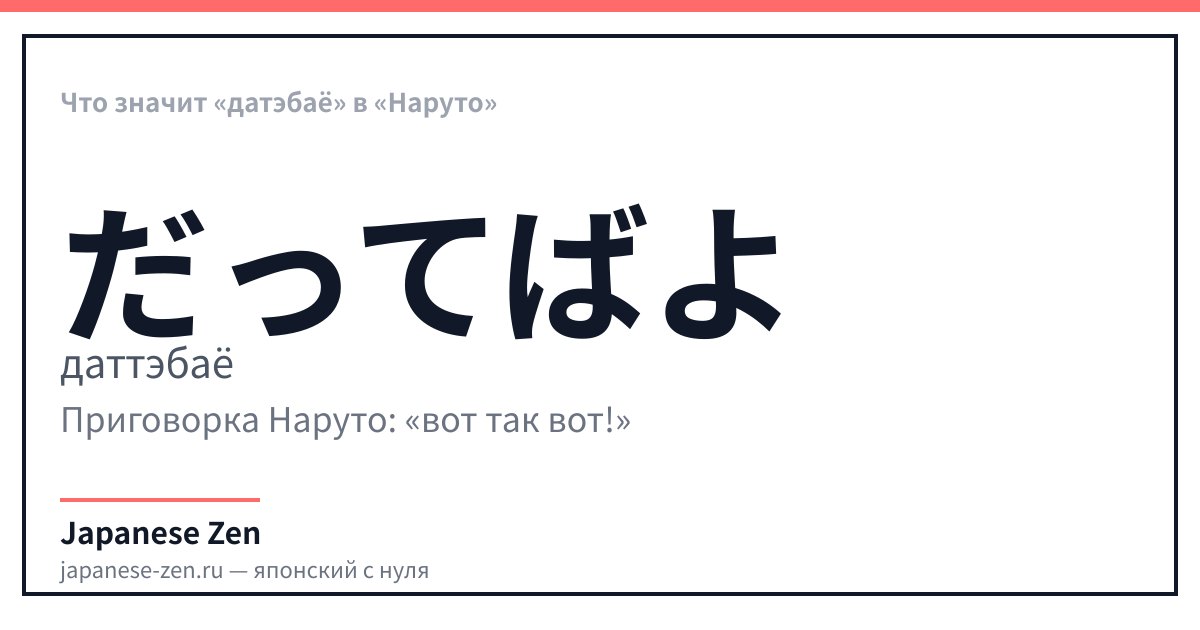
Fans have been searching for a translation for years, but there is nothing to find: the creators gave the character a speech habit, not a word. However, this example perfectly shows how Japanese uses sentence endings to convey personality.
What does “dattebayo” mean and why it can't be translated
The phrase is made up of grammatical particles: って is a colloquial reference to what was said, ば adds emphasis, and よ is an assertive ending. Together they don't create a meaning but an intonation: “I said so, and that's that.”
| Japanese | Reading | Translation |
|---|---|---|
| だってばよ | dattebayo · даттэбаё | Naruto's catchphrase: “that's how it is!” |
| だってば | datteba · даттэба | But I'm telling you! (colloquial form used in speech) |
| だよ | dayo · даё | That's right, I'm telling you (neutral emphasis at the end of a phrase) |
| だぜ | daze · дадзэ | That's how it is, bro (masculine bravado; used by Jotaro) |
| ですわ | desu wa · дэс ва | If you please (affected feminine ending, “rich young lady”) |
| にゃ | nya · ня | “Meow” instead of an ending (technique for cat-like characters) |
How Japanese colors speech with endings
This technique is called 語尾 (gobi) — “tail of the phrase.” The author only needs to assign a unique ending to a character, and the viewer recognizes them from a single line, without a label. Hence だってばよ for Naruto, だぜ for Jotaro, ですわ for the aristocrat, and のじゃ for the old sage. This is a purely Japanese tool for characterization: in Russian, the same role is played by filler words like “того-этого”.
How “dattebayo” is translated and whether you should use it
- The English dub came up with “Believe it!” — not accurate in meaning, but it matched the rhythm and length of the line.
- Russian subtitles often omit the catchphrase: there is no direct equivalent in our language.
- Kushina's feminine version is だってばね (dattebane); her son Boruto uses だってばさ (dattebasa). A family trait.
- What not to do: don't add だってばよ to your Japanese speech — it will sound like a quote from a cartoon.
- A real-life equivalent that is actually used is だってば: “well, I'm telling you”.
Where the double “t” comes from
“Dat-te-ba-yo”, the double “t” is not a decoration: it's a geminated consonant, a separate mora, with a short pause before it. Without it, you get “datebayo”, which is how it's written in Russian, although “dattebayo” is more accurate.
Say the phrases out loud — the app will check if you hold the geminated consonant.
FAQ
- What does “dattebayo” mean?
- It has no meaning of its own. It's a made-up catchphrase for Naruto that gives his sentences a stubborn, cheeky tone — like “that's how it is!”
- Why do they say “Believe it” in the English dub?
- They chose a replacement that matched the length and rhythm of the line. The original phrase has no meaning, because だってばよ itself has none.
- Who else has such a catchphrase?
- Naruto's mother uses だってばね, and Boruto uses だってばさ. The author made it a family speech trait.
- How do you write “dattebayo” in Japanese?
- In hiragana: だってばよ. There are no kanji in the catchphrase; it consists of grammatical particles.
Updated: 2026-07-25