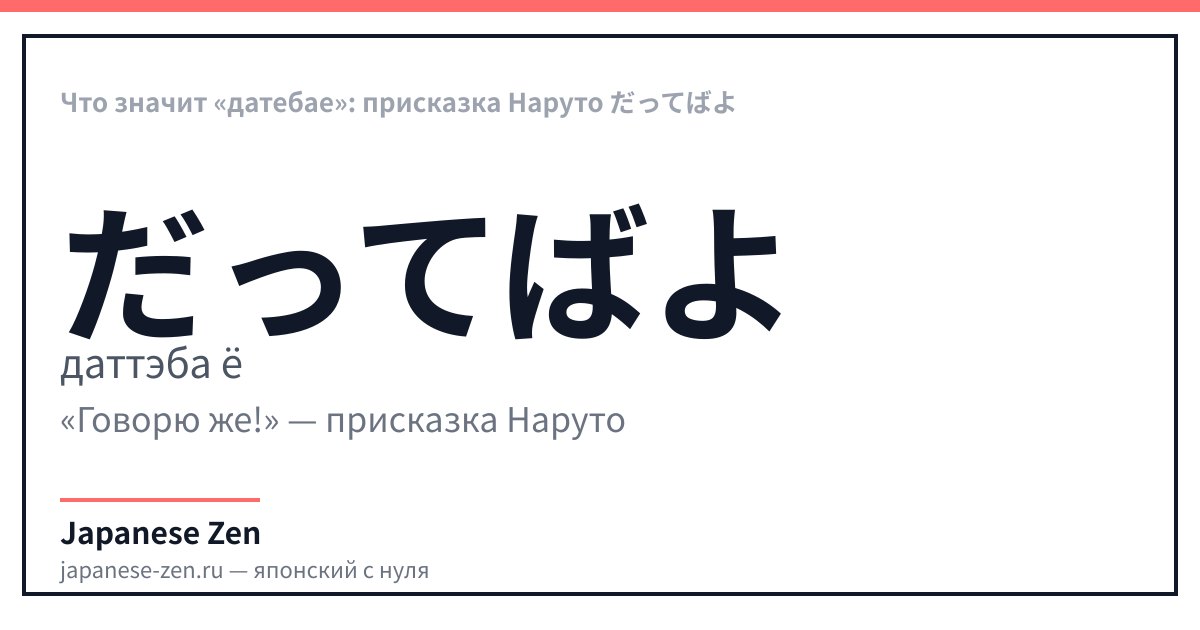
What "dattebayo" means: Naruto's catchphrase だってばよ
"Dattebayo" (more precisely "datteba yo", だってばよ) literally means nothing: it's a speech habit of Naruto Uzumaki, invented for him by manga author Masashi Kishimoto. It's built from colloquial particles — だ "is", ってば "I'm telling you", よ "you know" — so in meaning it's like "I'm telling you!" or "that's how it is!".
Fans spell the word any way they like — dattebayo, datteba yo, dattebayo — and look for a translation. There isn't one: it's not vocabulary but intonation written in letters. Let's break down which particles it's made of, where the catchphrase has relatives in Naruto's family, and how the real Japanese "I'm telling you" sounds.
What "datteba yo" is made of
Each part of the catchphrase is an ordinary colloquial particle. だ is the plain copula "is, am", the colloquial replacement for です. ってば adds impatience: that's how you speak when repeating something already said — "I told you". よ at the end adds emphasis, like English "you know". Together it comes out as "I'm telling you!", only without the words "I'm telling".
| Japanese | Reading | Translation |
|---|---|---|
| だってばよ | datteba yo · datteba yo | "I'm telling you!" — Naruto's catchphrase (in ordinary speech it sounds like a quote from "Naruto") |
| ってば | tteba · tteba | "I'm telling you" — an impatient reminder |
| もういいってば | mō ii tteba · mō ii tteba | Enough already, I said! |
| 行くってば | iku tteba · iku tteba | I'm coming, I'm coming! |
| だってばね | datteba ne · datteba ne | Kushina's catchphrase, Naruto's mother |
| だってばさ | datteba sa · datteba sa | Boruto's catchphrase, Naruto's son |
Why the catchphrase has no translation
Japanese manga authors often give a character a kuchiguse (口癖) — a verbal habit by which you recognize them from a single line. For Naruto it's だってばよ at the end of loud phrases. It adds no more meaning than "you know" in English speech, but it works as the character's signature: you hear "datteba yo" and you know who's talking.
The catchphrase by inheritance
In the story the habit turns out to be a family one. Naruto's mother, Kushina, ended her phrases with だってばね (datteba ne), and his son Boruto says だってばさ (datteba sa). Only the last particle changes: よ sounds forceful, ね — softer, さ — casual, while the frame "datteba" stays.
How "datteba yo" is translated and what to say yourself
- English subtitles most often omit the catchphrase or convey it through intonation: "I'm telling you", "that's how it is", "got it?".
- In the English dub of the first seasons it was replaced with the phrase Believe it! — it kept the force and matched the lip movements. Later it was dropped.
- In real speech Japanese people don't say だってばよ: outside anime the phrase sounds like a quote from "Naruto".
- The real "I'm telling you" in Japanese is ってば without だ and よ: もういいってば (mō ii tteba) "enough already".
How it's pronounced
"Dat-te-ba-yo": the small っ doubles the "t", and て is read as "te", without palatalization. That's why "datebayo" is the spelling farthest from the original, even though it's the one people search for most. There's no stress in the English sense; the syllables sound even.
Say the catchphrase out loud — the app will hear whether you pause on the doubled "t".
FAQ
- What does "dattebayo" mean?
- It's Naruto's catchphrase だってばよ (datteba yo). There's no literal translation; in meaning it's "I'm telling you!", "that's how it is!".
- Which is correct: datebayo, dattebayo, or datteba yo?
- In Hepburn romanization it's "datteba yo": double "t" and "yo". The other spellings are fan-made.
- Do Japanese people say this in real life?
- No, the phrase immediately refers to "Naruto". The real "I'm telling you" is the particle ってば: もういいってば "enough already".
- How does the catchphrase sound with Kushina and Boruto?
- With Kushina it's だってばね (datteba ne), with Boruto it's だってばさ (datteba sa).
- Why does Naruto say Believe it in the English version?
- That's how だってばよ was replaced in the first seasons of the dub, to keep the force and match the lip movements. Later the phrase was removed.
Updated: 2026-09-14