What does "daisuki" mean in Japanese
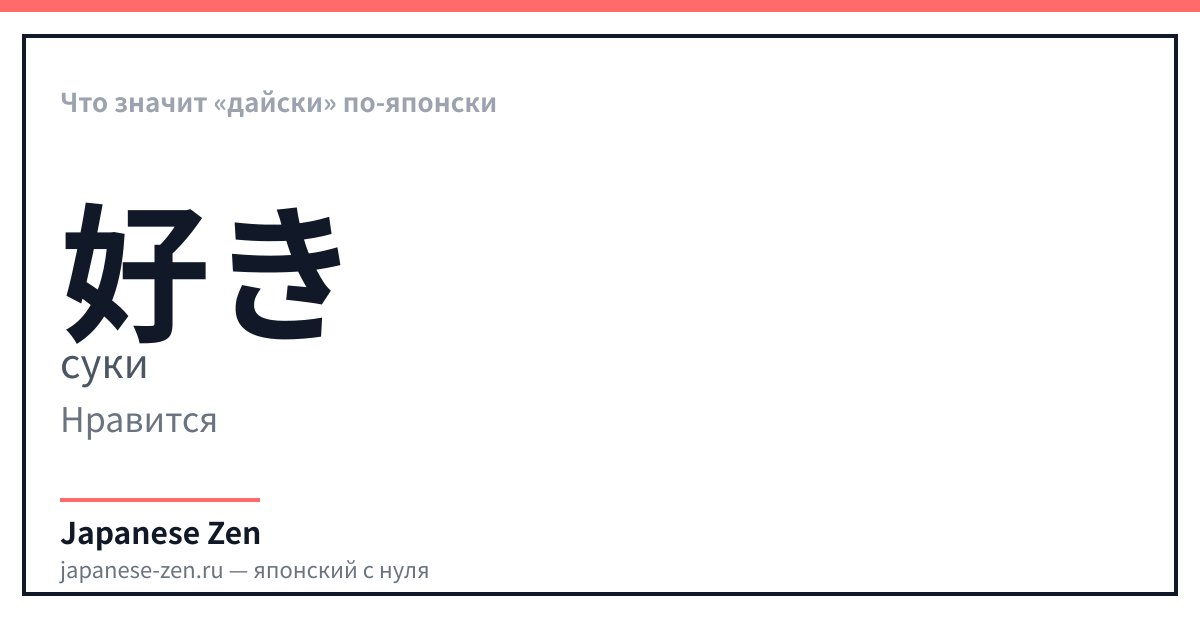
"Daisuki" (大好き) means "really like, adore": 大 — big, 好き — like. It is stronger than 好き, but softer than 愛してる ("love"). It is 大好き that Japanese people most often say in a confession: the direct "love" sounds so weighty that it is almost never used in everyday life.
In Japanese, people confess not with the word that a Russian speaker expects. Let's break down the ladder from "like" to "love" and where daisuki stands on it.
The ladder of feelings: from suki to aishiteru
| Japanese | Reading | Translation |
|---|---|---|
| 好き | suki · suki | Like |
| 大好き | daisuki · daisuki | Really like, adore |
| 愛してる | aishiteru · aishiteru | Love (sounds very weighty, rarely used in everyday life) |
| 気になる | ki ni naru · ki ni naru | Can't get out of my head (first stage of affection) |
| 付き合ってください | tsukiatte kudasai · tsukiatte kudasai | Be my partner (confession formula) |
| 大好きだよ | daisuki da yo · daisuki da yo | You are very dear to me (warm colloquial form) |
Why "love" is almost never said
愛してる is perceived as a statement of something serious and lifelong, so it is rarely said in a couple — sometimes once in a lifetime. Everyday tenderness is carried by 大好き, and it is not "weaker", but simply a different register: like the Russian "you are the best for me" instead of a formal confession.
Where else daisuki is heard
- About food and activities: 寿司が大好き ("I adore sushi") — here the word is neutral and said by everyone.
- About people: 大好き without context is read as a confession, so be careful with acquaintances.
- The particle changes the meaning: 猫が好き ("I like cats") and 猫は好き ("I like cats, but not others").
- Negation: 好きじゃない ("don't like") sounds softer than 嫌い ("dislike, disgusting").
- What not to do: don't translate 大好き as "love" in subtitles about food — it will come out comical.
Say it out loud — the app will compare with the reference recording.
How people actually confess
The confession formula is 好きです。付き合ってください ("I like you, be my partner"). It sounds mundane, but it is this phrase that starts a relationship: Japanese culture prefers clarity of action to loudness of words.
FAQ
- What does "daisuki" mean?
- 大好き — "really like, adore". Stronger than 好き, but softer than 愛してる.
- How to say "love" in Japanese?
- 愛してる, but it sounds very weighty. In everyday life, 大好き is more common.
- Can you say "daisuki" about food?
- Yes, it's a common usage: 寿司が大好き — "I adore sushi".
- What phrase do people confess with in Japan?
- 好きです。付き合ってください — "I like you, be my partner".
Updated: 2026-07-25