What does 'kouhai' mean in Japanese
'Kouhai' (後輩) means a junior comrade — someone who joined a school, club, or company after you. The characters are read as 後 'later' and 輩 'comrade'. An important detail: you don't call someone 'kouhai' to their face; it's a descriptive word. Juniors are addressed by surname with -kun or -san, while seniors are called directly: 先輩.
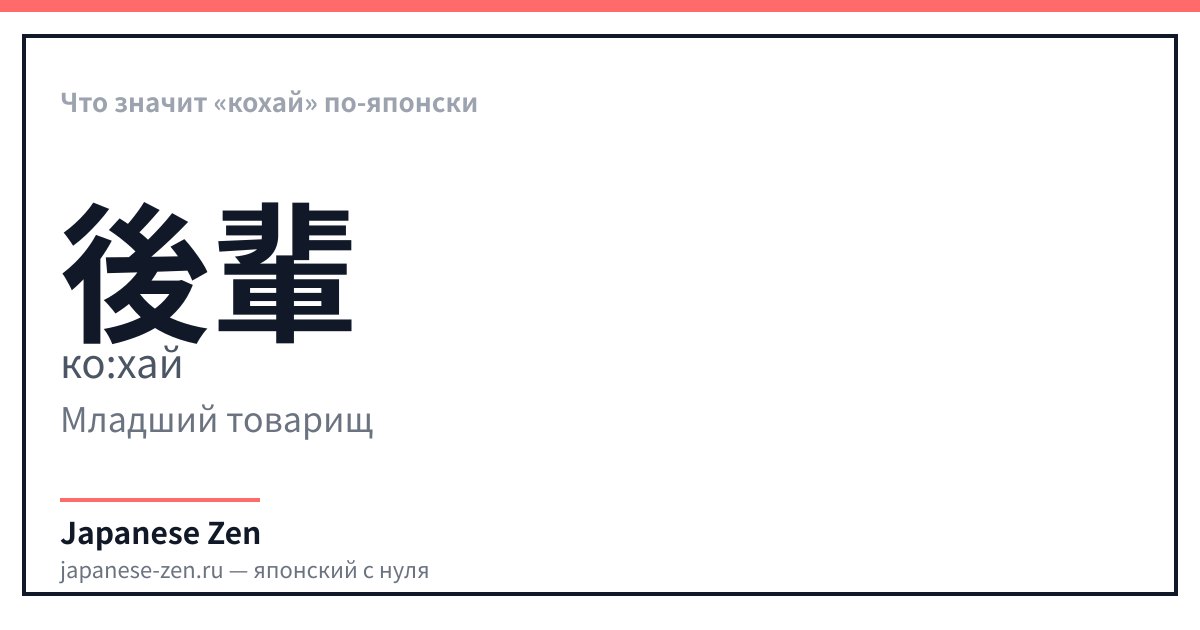
The senpai-kouhai pair holds up all of Japanese hierarchy, but it works asymmetrically: one word is used as a form of address, the other only when talking about a person. Let's break down why.
What does 'kouhai' mean and who becomes one
| Japanese | Reading | Translation |
|---|---|---|
| 後輩 | kouhai · ko:hai | Junior comrade |
| 先輩 | senpai · senpai | Senior comrade |
| 同期 | douki · do:ki | Those who joined the same year (equal in seniority) |
| 新人 | shinjin · shinjin | Newcomer (about a first-year person) |
| 面倒を見る | mendou o miru · mendo: o miru | To look after, to take care of (what a senpai does for a kouhai) |
Why 'kouhai' is not said to someone's face
Addressing a junior as 'kouhai' openly points out their place — in Japanese, that sounds arrogant. So they are called by surname: 田中くん. But 先輩 works like a name: you can simply call out 'senpai' to a senior, and it's polite.
How senpai-kouhai relationships work
- It's based on when you joined, not age: a forty-year-old newcomer to a company is the kouhai of a twenty-five-year-old.
- The kouhai speaks politely (desu/masu), the senpai replies in plain form — that's the norm, not rudeness.
- The senpai informally teaches: explains things not in the manual and answers for the junior's mistakes to superiors.
- In school clubs, juniors traditionally handle preparation and cleaning — hence the plots in anime.
- What not to do: don't immediately establish a hierarchy with a Japanese person — if they haven't brought it up, it's better to stick with neutral -san.
Say it out loud — the app will compare with the reference recording.
What this means in practice
Understanding this pair explains half of the behavior in a Japanese office and school: who speaks first, who pours tea, who answers the phone. For a foreigner, this knowledge is useful not to follow the hierarchy, but to not be surprised by it.
FAQ
- What does 'kouhai' mean?
- 後輩 — a junior comrade at school, club, or work: someone who joined after you. It's based on seniority, not age.
- Can you call someone 'kouhai' to their face?
- No, it's a descriptive word. Juniors are addressed by surname with -kun or -san.
- How is kouhai different from senpai?
- They are two sides of the same pair: the senpai joined earlier and informally looks after, the kouhai joined later and speaks more politely.
- How is 'kouhai' written in Japanese?
- 後輩, in kana こうはい. The first vowel is long: 'ko:hai'.
Updated: 2026-07-25