What does "one-chan" mean in Japanese
"One-chan" (お姉ちゃん) means "big sister" — an affectionate way for a younger person to address their older sister. The male counterpart is 兄ちゃん (nii-chan), "big brother." By changing the ending, you change the tone: ‑chan is affectionate, ‑san is neutral, ‑sama is respectful. Younger siblings are never addressed this way — they are called by name.
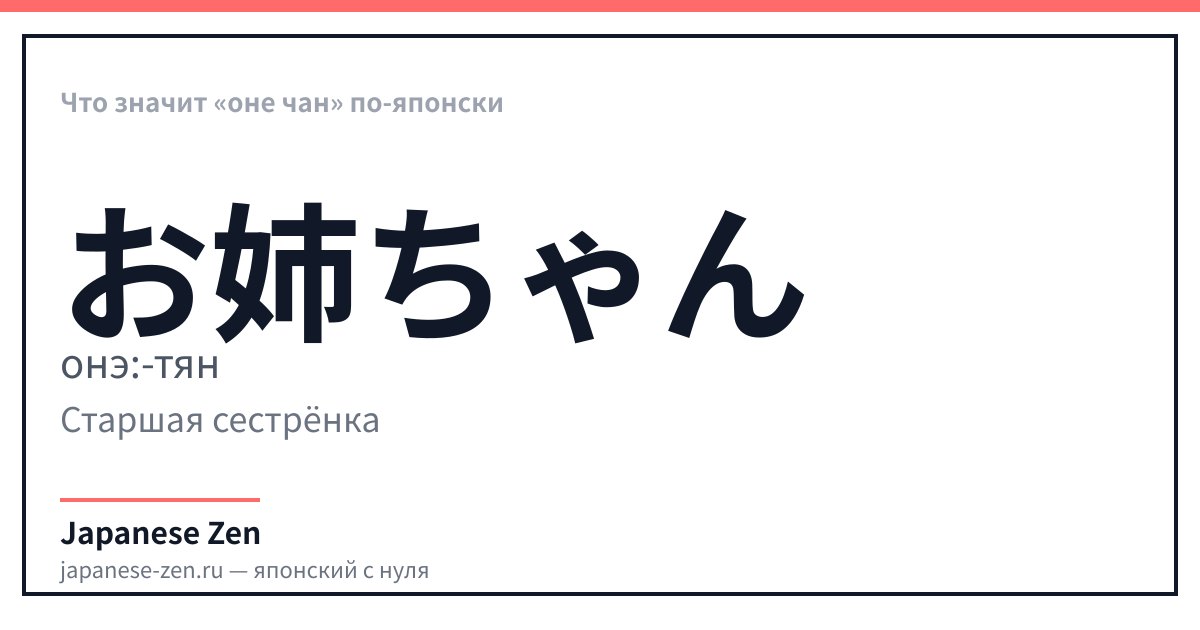
Everyone knows the word from anime, but almost no one notices: in Japanese, you address older people by their role, and younger people by their name. This is not a polite formality, but the basic logic of family words, and on it are built "onee-san," "nii-sama," and all other variants.
What does "one-chan" mean and what variants are there
| Japanese | Reading | Translation |
|---|---|---|
| お姉ちゃん | onee-chan · one:-chan | Big sister (affectionate) |
| お姉さん | onee-san · one:-san | Big sister (neutral) (also used to address an unfamiliar young woman) |
| 姉 | ane · ane | My older sister (used when talking about her to others, not to her directly) |
| お兄ちゃん | onii-chan · oni:-chan | Big brother (affectionate) (male counterpart) |
| 妹 | imouto · imo:to | Younger sister (not used as a form of address — younger siblings are called by name) |
| お姉様 | onee-sama · one:-sama | Sister (respectful) (old-fashioned and ceremonial, often used jokingly) |
"One-chan" or "oni-chan" — don't confuse them
The difference is one sound, but the gender changes: お姉ちゃん (one:-chan) is sister, お兄ちゃん (oni:-chan) is brother. In both words the vowel is long: "one:" and "oni:", and it is this length that distinguishes them from other words. The Russian spelling "one chan" and "oni chan" loses this length, hence the confusion.
姉 — значение: older sister — онъёми: シ — кунъёми: あね、はは — 8 штрих(ов). 姉 — the kanji for older sister, level N3. Click "Show stroke order" to see how to write it by hand.
How to address family members in a Japanese family
- To older members — by role: お姉ちゃん, お兄ちゃん, お母さん (mom), お父さん (dad).
- To younger members — by name, often with ‑ちゃん or ‑くん: "Yuki-chan", not "imouto".
- When talking about your own relatives to outsiders, use simple words without prefixes: 姉 (my older sister), 母 (my mother).
- About someone else's sister — politely: お姉さん. Using this same form for your own in a business conversation is considered a mistake.
- You can address an unfamiliar young woman on the street as お姉さん — roughly like the Russian "devushka" (young lady).
What does "‑chan" add
The suffix ‑chan makes the address homely and warm: children and close people use it. With age, many switch to お姉さん, but in the family the affectionate form often remains forever — like the Russian "sestryonka" from the mouth of an adult.
Say the addresses aloud — the app will compare with the reference recording and show whether you are keeping the vowel length.
FAQ
- What does "one-chan" mean in Japanese?
- お姉ちゃん — "big sister", an affectionate address from a younger person to an older sister.
- How is "one-chan" different from "onii-chan"?
- お姉ちゃん (one:-chan) is sister, お兄ちゃん (oni:-chan) is brother. They differ by one sound, but the gender changes.
- How to address a younger sister?
- By name, usually with ‑ちゃん. The word 妹 (imouto) is only for talking about her, not as a form of address.
- How do you write "one-chan" in Japanese?
- お姉ちゃん. In kana: おねえちゃん — note the long "e".
Updated: 2026-07-25