What does 'ora ora' mean in Japanese
'Ora ora' (オラオラ) is a rough shout like 'come on!' or 'hey, you!' used to urge someone on or attack an opponent. In 'JoJo's Bizarre Adventure' it's Jotaro's battle cry during a flurry of punches, paired with his enemy's 無駄無駄 (muda muda). In everyday Japanese, a single おら is a familiar 'hey!', and a オラオラした person is cocky and aggressive.
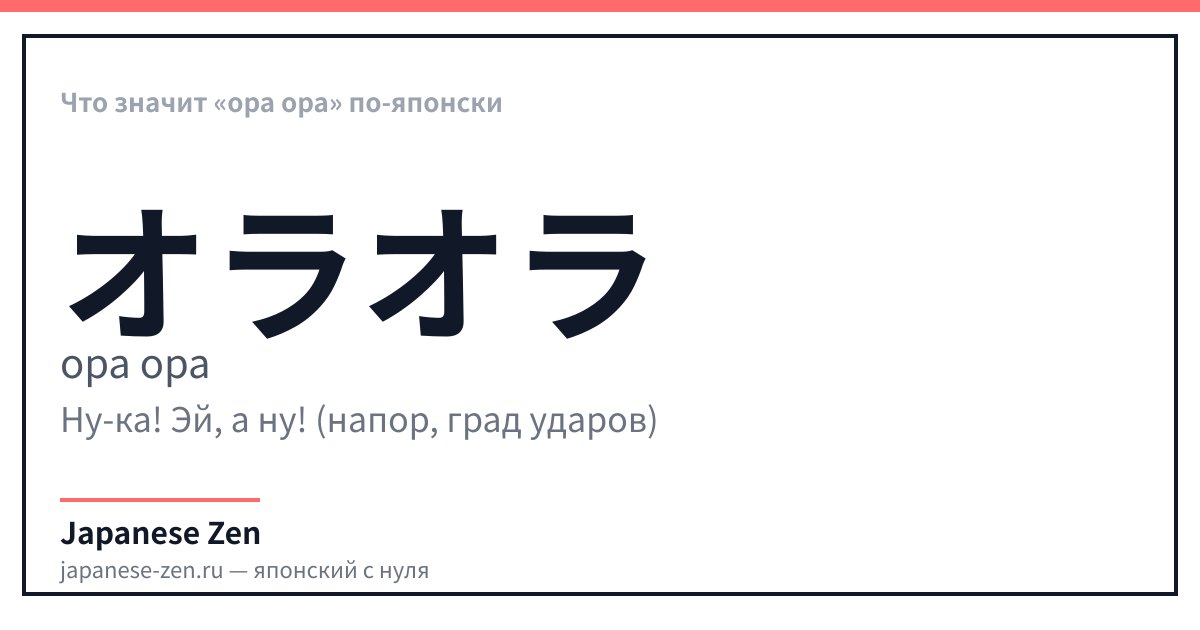
The phrase is known as the sound of a barrage of punches, but it also has a mundane life: the same word is used by a construction worker to call out to a yawning passerby. Let's break down both layers — and also the second half of the famous battle cry duel.
What does 'ora ora' mean and how is it used
おら is an old shout used to get attention: 'hey!', 'come on!'. Repetition turns it into pressure, so in battle it sounds like 'take this!', and in life like 'what's your problem, huh?'.
| Japanese | Reading | Translation |
|---|---|---|
| オラオラ | ora ora · ora ora | Come on! Hey, you! (pressure, barrage of punches) |
| おら | ora · ora | Hey! (rough shout) (single form, sounds masculine and sharp) |
| 無駄無駄 | muda muda · muda muda | Useless! In vain! (Dio's answering cry — paired with ora-ora) |
| オラオラ系 | oraora-kei · oraora-kei | Cocky, aggressive type (fixed expression for a pushy manner) |
| こら | kora · kora | Hey! What do you think you're doing! (shout, reproach) (softer, used to scold a child) |
'Ora ora' vs 'muda muda'
無駄 (muda) means 'in vain, useless', a common word: 無駄な時間 — 'wasted time'. The cry 無駄無駄 in the duel means 'everything is useless', unlike the offensive オラオラ. Thus the author's pair of cries conveys personalities: one presses with force, the other denies the meaning of resistance.
How it sounds outside anime
- オラオラ系 (oraora-kei) — a description of a manner: cocky, pushy, 'acting tough'. Often used for driving style or communication.
- A single おら in eastern Japan dialects also means 'I' — a rural, old-fashioned pronoun.
- こら is a related shout, but softer: used to scold a misbehaving child.
- What not to do: don't shout at strangers like that — it's rude, not a cheerful greeting.
- In manga translations, オラオラ is usually left as is: it's a sound, not a word with meaning.
How to pronounce
'O-ra o-ra', both words are short and identical, the 'r' sound is a single tap. In battle, the phrase is said on an exhale with increasing intensity, but the vowels themselves are not stretched — it's rhythm, not elongation.
Say the cries aloud — the app will compare with the reference recording.
FAQ
- What does 'ora ora' mean in Japanese?
- オラオラ is a rough shout 'come on!', 'hey, you!'. In battle it sounds like pressure under a barrage of punches.
- What does the opponent shout in response?
- 無駄無駄 (muda muda) — 'useless, in vain'. It's Dio's paired cry to Jotaro's 'ora-ora'.
- How is 'ora ora' written in Japanese?
- In katakana オラオラ — to emphasize it's a cry. Hiragana おらおら also occurs.
- Do people say 'ora ora' in real life?
- Yes, as a sharp shout and in the expression オラオラ系 — 'cocky type'. It's rude to address strangers that way.
Updated: 2026-07-25