Gaki — Who Are They in Japanese Mythology
Gaki (餓鬼) is a hungry ghost from Buddhist cosmology, which Japanese mythology absorbed entirely: greed or envy in a past life condemned it to eternal hunger with a bloated belly and a needle-thin throat. It is impossible to satisfy — food and water turn into fire in its mouth. The same word gives rise to the modern colloquial 'gaki' — 'brat, squirt'.
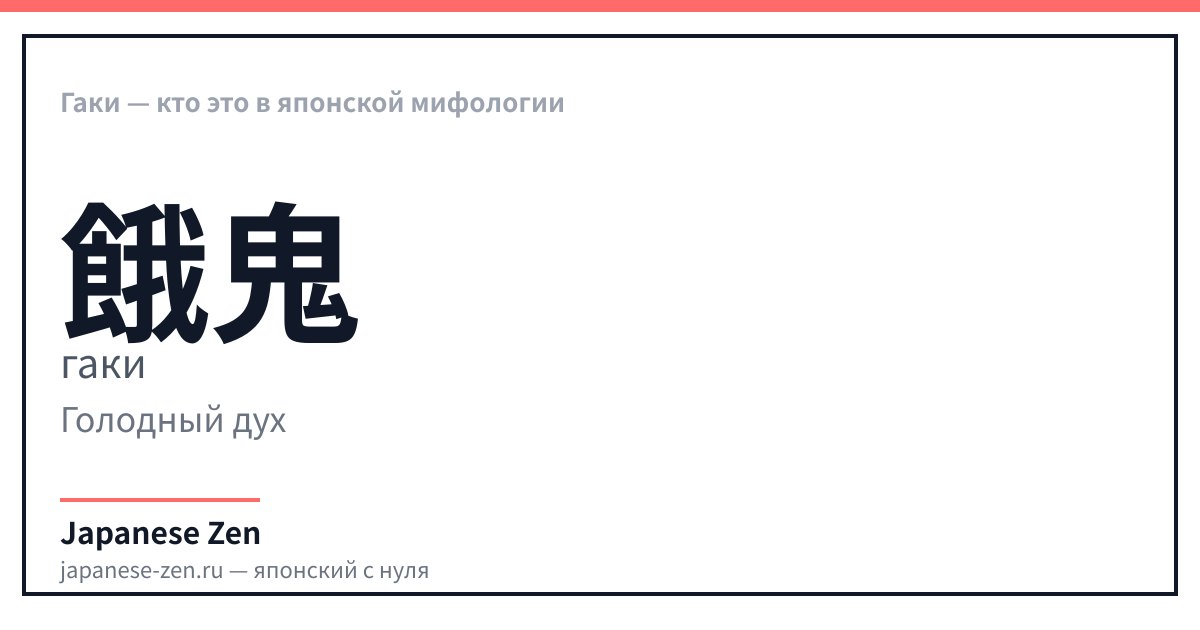
Gaki is not so much a myth character as a vivid Buddhist punishment: a body that physically cannot be satiated, an eternal demonstration of where greed leads.
Who is gaki and why is it eternally hungry
Gaki — 'hungry ghost', one of the six realms of rebirth in Buddhist cosmology (Sanskrit: preta): souls that were excessively greedy, envious, or miserly in life end up there. The punishment is built on direct physical irony: a bloated belly with a needle-thin neck, so gaki simply cannot push enough food into itself. And any food or water it does touch bursts into flames or turns to blood in its mouth.
- Cause of rebirth: greed, envy, miserliness in a past life.
- Appearance: bloated belly, thin neck, emaciated body.
- Curse: inability to be satiated at all — food turns into poison or fire.
- Salvation: the segaki ritual (施餓鬼) — monks ritually feed the hungry ghosts.
Why it is absent from Shinto chronicles
Gaki came not from Shinto chronicles, but from Buddhist texts and paintings. The main visual source is the 'Gaki-zōshi' (餓鬼草紙, 'Scroll of Hungry Ghosts'), an illustrated scroll from the 12th century and a national treasure of Japan: in it, gaki wander the streets of Kyoto among unsuspecting passersby.
餓鬼 — 'hungry demon'
| Japanese | Reading | Translation |
|---|---|---|
| 餓鬼 | gaki · gaki | Hungry ghost |
| 施餓鬼 | segaki · segaki | Ritual of feeding hungry ghosts |
| 餓える | ueru · ueru | To starve |
| ガキ | gaki · gaki | 'Brat, squirt' — colloquial insult |
| 六道 | rokudō · rokudō | Six realms of rebirth |
How 'hungry demon' became the word 'brat'
餓鬼 is read がき (gaki): 餓 — 'to starve, to be famished', 鬼 — 'demon'. Literally — 'hungry demon'. In modern colloquial language, the word has broken away from the Buddhist context and become a rude address to a disobedient child — 'brat'.
餓 — значение: to starve, hungry, thirst — онъёми: ガ — кунъёми: う.える — 15 штрих(ов). 餓 — 'to starve': on the left the radical 'food' 食, on the right the phonetic 我 'I'. Hunger as what happens to 'food in relation to me'.
Write 餓 along the guides and learn the stroke order.
Gaki in 'Bleach' and yokai series
- 'Bleach' — the concept of hungry, never-satisfied spirits directly echoes the idea of gaki in Buddhist cosmology of the afterlife.
- 'Death Note' and other stories about afterlife worlds sometimes use the imagery of a bloated belly and thin neck for 'cursed' characters.
- The word 'gaki' in the sense of 'brat' regularly appears in everyday dialogues in school anime — already without any mysticism.
Where the figure with a bloated belly came from
The emaciated figure with a bloated belly is a direct borrowing from the Buddhist iconography of India and China, where the image of the hungry ghost took shape several centuries before the Japanese scrolls.
How gaki are 'fed'
- The segaki ritual — Buddhist monks recite sutras and set out offerings specifically for hungry ghosts, often during Obon.
- Offerings are placed separately from offerings to ancestors — it is believed that gaki might, by mistake or envy, take someone else's food.
- In some temples, segaki is held annually as a separate service, not tied to Obon.
- The purpose of the ritual is not expulsion, as with oni, but rather the alleviation of suffering — gaki is not an enemy, but an object of compassion.
FAQ
- Is gaki a Shinto creature or a Buddhist one?
- Strictly speaking, it is a Buddhist, not Shinto, concept: a hungry ghost, one of the forms of posthumous rebirth for greed or envy in a past life. Gaki is not a god.
- Why is gaki doomed to hunger?
- It is not responsible for anything — it is not a patron, but a suffering soul. Gaki symbolizes the consequences of greed: eternal hunger with the physical impossibility of being satiated.
- How is 'gaki' written and what do these characters mean?
- 餓鬼 (がき): 餓 'to starve' plus 鬼 'demon'. In colloquial language, the same word, apart from mythology, means 'brat, disobedient child'.
- Is the idea of gaki reflected in anime?
- There are few direct adaptations, but the concept of hungry, eternally unsatisfied spirits echoes the afterlife worlds in 'Bleach' and similar stories about the afterlife.
- How are gaki treated in Japan?
- They are not worshipped, but fed: the segaki ritual, often during the Obon festival — Buddhist monks set out offerings specifically for hungry ghosts to alleviate their suffering.
- Is gaki a god or a spirit?
- A spirit, and in a Buddhist, not Shinto, sense — a form of posthumous rebirth, not a deity. This is a fundamentally different system of concepts than the kami pantheon.
Sources
Updated: 2026-08-29