Kaishaku — who is the second at seppuku
Kaishaku (介錯) is the second at seppuku: the person who, with a single sword stroke, ended the death throes of one who had disemboweled himself. The character 介 means 'to help,' so in Japan itself this role was seen not as killing but as a final service and a sign of the highest trust between people.
To an outsider, this seems like an execution. For the Japanese themselves, the role of kaishaku was the opposite: not to take a life, but to spare a friend or comrade unnecessary suffering.
What the kaishaku did and why it was not considered murder
Kaishaku (介錯人, kaishakunin) is the one who assisted the samurai during seppuku and ended his suffering with a fatal sword stroke at the right moment of the ritual. In Japanese tradition, this was not equated with murder: the kaishaku performed a formal part of the ceremony, sanctioned both by the sentence and by the condemned person himself, and did not act on his own will.
- Who was asked: a close friend, a relative, or the most respected swordsman among those present.
- Why it was an honor: the role required complete trust — a bad stroke turned a dignified death into an agonizing one.
- What was required of the kaishaku: impeccable swordsmanship — one movement decided whether the ceremony would pass with dignity.
- How it was judged from outside: refusing a request to become kaishaku was considered almost as disgraceful as refusing seppuku itself.
Why this was called a service, not an execution
At the root of the word 介錯 lies the idea of help, not punishment. It was possible to refuse, but the request to become kaishaku was considered a sign of the greatest trust — only people whose skill and integrity were beyond doubt were asked.
Words and characters: 介錯
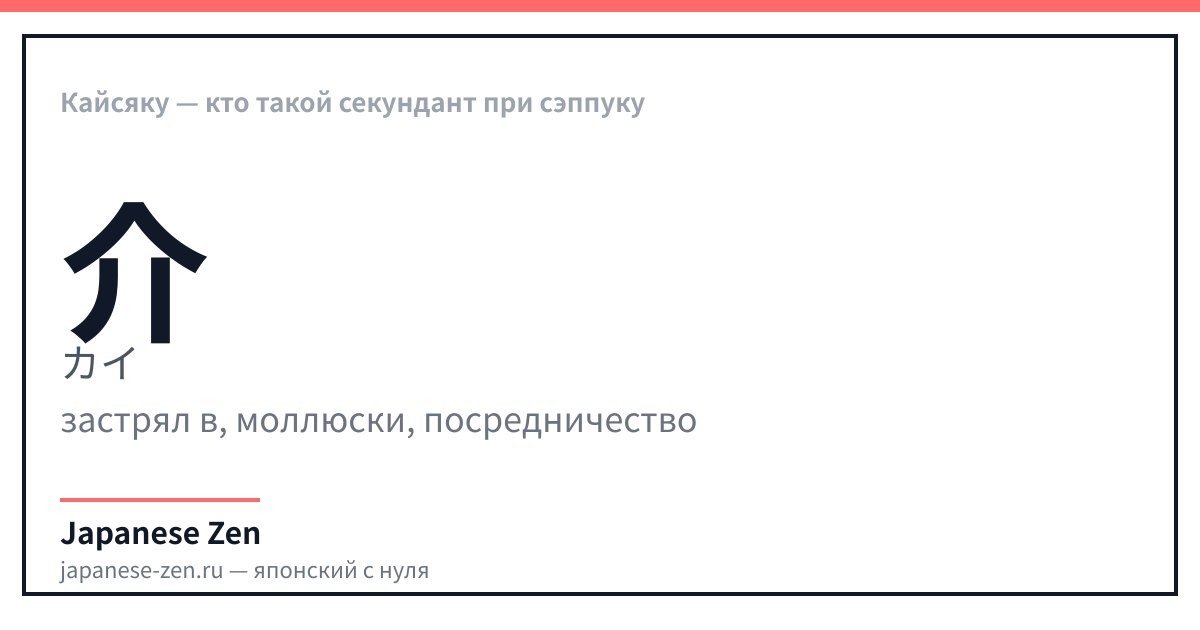
介 — значение: stuck in, shellfish, mediation, care for oneself — онъёми: カイ — 4 штрих(ов). 介 — 'to help, to mediate': the same sign in 紹介 (shōkai, 'introduction, acquaintance') and 介護 (kaigo, 'nursing care'). In 介錯 (kaishaku), the same idea of help extends to the most serious situation — help in dying with dignity.
| Japanese | Reading | Translation |
|---|---|---|
| 介錯 | kaishaku · kaishaku | The role of second at seppuku |
| 介錯人 | kaishakunin · kaishakunin | The person performing this role |
| 切腹 | seppuku · seppuku | The ritual that requires a kaishaku |
| 信頼 | shinrai · shinrai | Trust |
介錯 — an action on behalf of another
介錯 breaks down into 介 'to help, to mediate' and 錯, which in this combination indicates the action itself performed on behalf of another person. Together, the word literally describes not a blow, but assistance in completing the ritual.
Listen to the word kaishaku and related terms — the app will evaluate your pronunciation.
Kaishaku in anime
The role of the second in anime is shown rarely and almost always seriously — unlike parodic harakiri scenes.
- Rurouni Kenshin — the theme of readiness to become a second surfaces in conversations about samurai duty.
- Afro Samurai — the motif of a blow ending another's life by agreement echoes the role of kaishaku, although it is not directly named.
FAQ
- What is kaishaku?
- 介錯 — the second at seppuku: the one who, with a single sword stroke, ended the death throes of the condemned. In Japan, this was considered a service, not murder.
- Why was the role of kaishaku not considered murder?
- Because he acted by agreement and within the framework of a sanctioned ritual, not on his own will. The character 介 literally means 'to help.'
- Who was asked to become kaishaku?
- A close friend, a relative, or the most skilled swordsman among those present — the request was considered a sign of the highest trust.
- Why did the role of kaishaku require masterful swordsmanship?
- One precise stroke had to instantly end suffering; an inaccurate stroke turned the ceremony into agony — such a mistake was unforgivable.
- How is 'kaishaku' written in Japanese?
- 介錯, in kana かいしゃく. 介 — 'to help,' 錯 indicates the action itself performed for another.
Sources
Updated: 2026-08-29