Japanese Nickname: How to Make One in 4 Steps
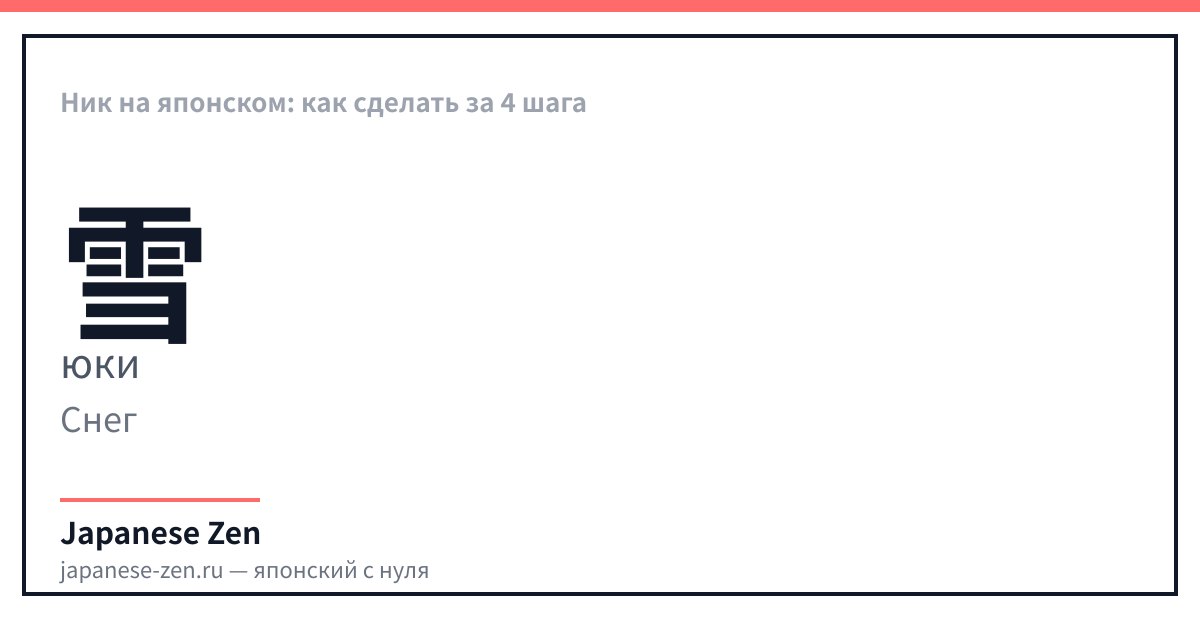
A Japanese nickname is made in two ways: write your name in katakana (Anya → アーニャ) or take a Japanese word by meaning (雪 'yuki' — snow). Katakana is for names and foreign words, kanji is for meaningful nicknames. The main rule: don't mix random characters, a Japanese person will read it as nonsense.
A nickname made of random kanji looks to a Japanese person like a Russian nickname 'Table Moon Fast'. Two paths look good: an honest transliteration of your name in katakana or a single word that actually means something. Below are both, with verification.
How to Make a Japanese Nickname
- Decide what's more important: that your name is readable or that there's a meaning. Name — in katakana, meaning — in kanji or a Japanese word.
- For a name, break it into Japanese syllables. Japanese has no separate 'l', 'v', 'y' (as in 'y' in 'my'): Lena → レナ (Rena), Viktor → ヴィクトル (Vikutoru), Anya → アーニャ (A:nya). A long sound is indicated by a dash ー.
- For a meaningful nickname, choose ONE word from the table below and check its reading — that will be how the nickname is pronounced.
- Check the result: the word must exist as a whole. If you combined two characters yourself, there's a high chance of getting a non-existent combination.
Why Names Are Written in Katakana, Not Kanji
Katakana is the alphabet for everything foreign: names, brands, borrowings. A name is written in kanji only by selecting characters 'by sound', and then each character carries its own meaning: a bad selection turns Marina into 'evil pear'. Katakana is safer and looks normal to a Japanese person.
Japanese Words for a Meaningful Nickname
| Japanese | Reading | Translation |
|---|---|---|
| 雪 | yuki · yuki | Snow |
| 空 | sora · sora | Sky |
| 星 | hoshi · hoshi | Star |
| 夢 | yume · yume | Dream, aspiration |
| 光 | hikari · hikari | Light, radiance |
| 影 | kage · kage | Shadow |
| 風 | kaze · kaze | Wind |
| 海 | umi · umi | Sea |
| 狼 | ōkami · ōkami | Wolf |
| 狐 | kitsune · kitsune | Fox |
How to Write Your Name in Katakana
| Name | Katakana | How a Japanese Person Will Read It |
|---|---|---|
| Anya | アーニャ | A:nya |
| Sasha | サーシャ | Sa:sha |
| Lena | レナ | Rena |
| Dima | ジーマ | Dzi:ma |
| Kira | キラ | Kira |
| Maxim | マクシム | Makushimu |
| Vladimir | ウラジーミル | Uradzi:míru |
Mistakes That Make a Nickname Look Absurd
- Gluing kanji 'by meaning': 死光 does not mean 'deadly light', such a word doesn't exist.
- Taking a character from machine translation without reading: a single kanji often has 3–5 readings, and you won't know how the nickname is pronounced.
- Writing a name in hiragana: it's for Japanese words, a name in it looks like a child's writing.
- Adding suffixes like -san or -kun to your own nickname: that's what the interlocutor does, not you yourself.
Check How the Chosen Word Sounds
Say your nickname into the microphone — if you stumble over it yourself, you'll stumble in voice chat too.
FAQ
- How to make a Japanese nickname?
- Two ways: write your name in katakana (Anya → アーニャ) or take a Japanese word by meaning (雪 yuki — snow, 影 kage — shadow). Mixing random kanji is not allowed: it will be nonsense.
- Nickname in katakana or kanji?
- Katakana — if you want your name to be read. Kanji — if you need meaning. Writing a name in kanji 'by sound' is risky: each character brings its own meaning.
- How to write a Russian name in Japanese?
- Break it into syllables and replace missing sounds: 'l' → 'r', 'v' → ヴ or ウ, 'y' (as in 'my') → イ. Long vowels are indicated by a dash ー. Lena → レナ, Vladimir → ウラジーミル.
- Can I take one kanji as a nickname?
- Yes, it's the safest meaningful option — but find out the reading in advance. For example 影 is read 'kage', not 'ei': the reading will be how your nickname is pronounced.
- How to check that the nickname doesn't look stupid?
- Make sure the word exists as a whole (is in the dictionary), you know its reading, and it's one word. If the word is assembled by you from two characters and is not in the dictionary — almost certainly it's not said that way.
Updated: 2026-07-25