Characters of Japanese Mythology — Who They Include
Characters of Japanese mythology fall into three non-overlapping groups: kami gods from official chronicles, yokai from oral folklore, and legendary heroes like Momotaro — semi-folklore humans without divine status. The confusion usually arises because all three groups are equally called 'mythological characters' in translations.
Ask who a 'character of Japanese mythology' is, and you might get the sun goddess, a fox spirit, or a boy from a peach — formally these are three different classes of beings united only by the genre of the story.
Who Are the Characters of Japanese Mythology
'Character of Japanese mythology' is not a strict term but an umbrella name for three different categories of beings. They are easy to distinguish by one question: where the character comes from. Kami gods are recorded in the chronicles 'Kojiki' and 'Nihon Shoki' and have official genealogy and status. Yokai come from oral folklore and are not required to be gods. Legendary heroes like Momotaro or Kintaro are semi-human, semi-fairy-tale characters without divine origin, whose story is closer to a fairy tale than a myth.
- Gods (kami): Amaterasu, Susanoo — from official chronicles, with a clear genealogy.
- Yokai: kitsune, oni, jorogumo — from oral folklore, without genealogy.
- Legendary heroes: Momotaro, Kintaro — semi-fairy-tale humans without divine status.
- Deified historical figures: Sugawara no Michizane — a real person who became a kami after death.
Which of them were recorded in writing
The chronicles record only the first category — the gods. Yokai and legendary heroes are documented in much later and less 'official' sources: collections of fairy tales, yokai encyclopedias, theatrical plays — which explains the difference in the degree of reliability and status of characters within one conditional 'mythology'.
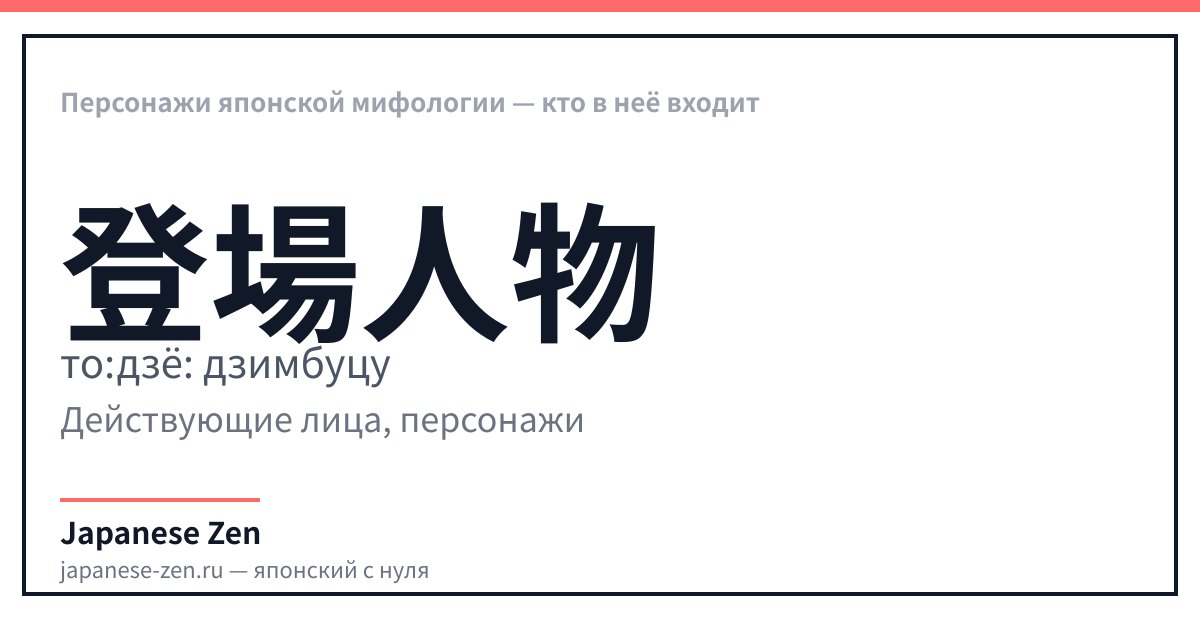
登場人物 — 'Dramatis Personae'
| Japanese | Reading | Translation |
|---|---|---|
| 登場人物 | tōjō jinbutsu · to:jo: jinbutsu | Dramatis personae, characters |
| 人物 | jinbutsu · jinbutsu | Person, personality |
| 英雄 | eiyū · eiyu: | Hero |
| 実在の人物 | jitsuzai no jinbutsu · jitsuzai-no jinbutsu | Real historical person |
| 架空の | kakū no · kaku:-no | Fictional |
Where the term came from in the language
登場人物 is read とうじょうじんぶつ: 登場 'entrance on stage, appearance' plus 人物 'person'. The term comes from theatrical vocabulary — literally 'people who appear [on stage]' — and today is equally applied to the heroes of a play and to the characters of a myth.
人 — значение: person — онъёми: ジン、ニン — кунъёми: ひと、-り、-と — 2 штрих(ов). 人 — 'person': a pictograph of a walking figure. It is part of 人物 (person) and hundreds of other words about people.
Write 人 along the guides — one of the first kanji at N5 level.
Where They Are Found in Japan
- Gods are worshipped at Shinto shrines throughout the country.
- Yokai 'live' in the local folklore of specific regions and lakes, mountains, forests.
- Legendary heroes like Momotaro and Kintaro are commemorated with monuments and museums in cities that consider themselves their birthplace.
- Deified people like Michizane receive their own temples — direct proof of the transition from the category 'person' to the category 'god'.
FAQ
- Who are the Characters in Shinto?
- In Shinto, strictly speaking, only kami gods. The term 'characters of Japanese mythology' is broader and in everyday use also includes yokai and legendary heroes without divine status.
- How do the characters of Japanese mythology differ from each other?
- By origin: gods are from official chronicles with genealogy, yokai are from oral folklore without it, legendary heroes are from fairy tales, usually without any divine status.
- How do you say 'dramatis personae' in Japanese?
- 登場人物 (とうじょうじんぶつ): 登場 'entrance on stage' plus 人物 'person'. The term comes from theatrical vocabulary, not from religious texts.
- Which anime mix all three categories at once?
- Almost any anime about yokai or gods immediately uses characters from all three categories mixed together — for example, in 'Naruto' or 'Natsume's Book of Friends'.
- Where in Japan are these characters found?
- Differently: gods are in shrines, legendary heroes are commemorated with monuments in the homeland of their tales. Yokai are not formally worshipped, but rather told about as local legends.
Sources
Updated: 2026-08-29