Ryōmen Sukuna — the two-faced figure from the Nihon Shoki: villain or hero
Ryōmen Sukuna is a character from the Nihon Shoki, an 8th-century Japanese chronicle: under this name it presents a man from Hida Province with two faces and four arms who refused to submit to the court and was killed by imperial order. The chronicle calls him a bandit, while the local Hida tradition instead remembers him as a hero and patron of the land.
The same man is a rebel in one text, yet in the oral memory of his own land he is the holy patron of a temple. The Nihon Shoki and the Hida tradition tell of Sukuna as if they were about two different people.
What the Nihon Shoki says about Sukuna
In the Nihon Shoki, in the section on the reign of Emperor Nintoku, it is briefly told: in Hida Province a man named Sukuna appeared. One body and two faces looking in opposite directions, two arms and legs on each side — four arms and four legs in total. The four hands held a bow and arrows, and a sword hung on each side. Sukuna did not recognize the court's authority and ravaged the local people, so the emperor sent the military commander Naniwa-no-neko Takefurukuma (難波根子武振熊), who killed him.
| Reign | Event |
|---|---|
| Emperor Nintoku (legendary dating — long before Heian) | In Hida Province, the two-faced, four-armed Sukuna appears |
| — | Sukuna does not submit to the court and ravages the district, according to the chronicle |
| — | The emperor sends Naniwa-no-neko Takefurukuma, who kills Sukuna |
Why the court called him a villain
The Nihon Shoki was written on the court's order and explained to the world why power in the country belonged to it: any regional chief who did not recognize the capital in such a chronicle almost had to look like a bandit. Sukuna of Hida seems to be exactly such a case — an independent figure on the periphery whom official history retroactively recorded as an enemy.
In Hida he is remembered differently
The local Hida tradition (north of present-day Gifu Prefecture) tells the opposite story: Sukuna defeats a poisonous dragon that tormented the district, and he is revered as the founder of Senkō-ji (千光寺) in Takayama. The temple chronicle Kesazan Senkōji-ki (袈裟山千光寺記, compiled in the early Edo period) goes even further and calls him an incarnation of the bodhisattva Guse Kannon (救世観音).
The temple that considers him its founder
Senkō-ji is still an active temple in Takayama, and in its own version of events the court in the capital simply did not know (or did not want to know) Sukuna's true role on the ground. The gap between the 'bandit' of the court chronicle and the 'temple founder and incarnation of a bodhisattva' of the local tradition is not an error in one of the versions, but two different views of the same character: imperial and regional.
両面 — 'two faces': breaking down the name's writing
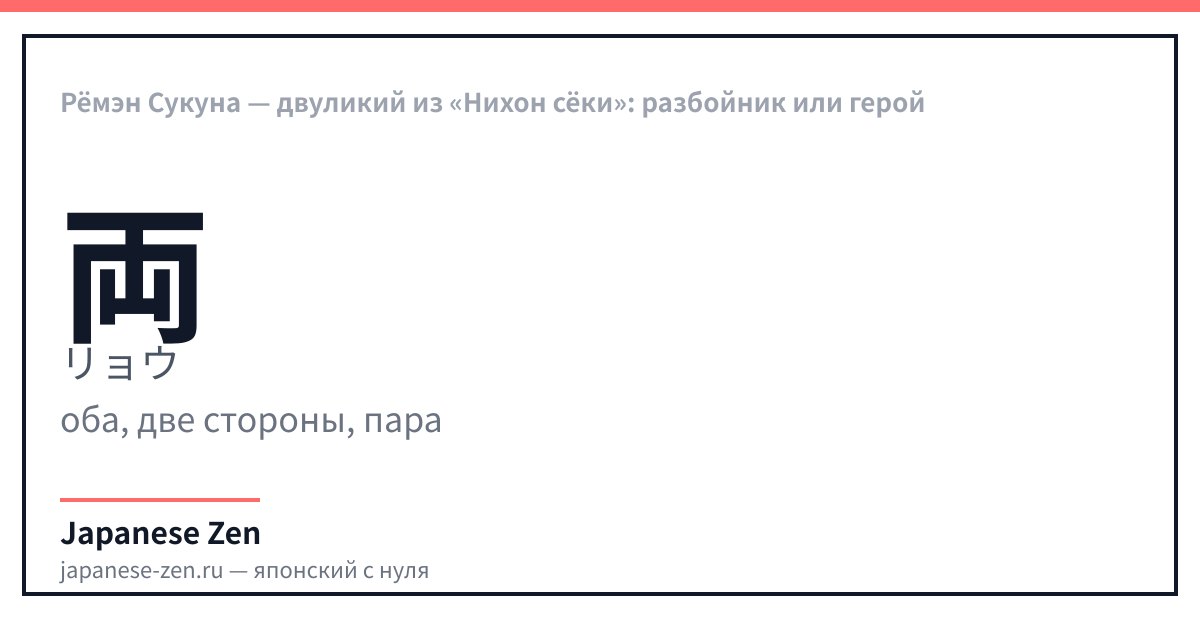
The full name is written 両面宿儺: 両面 — 'both sides, two faces' — a direct description of the appearance from the chronicle, and 宿儺 — the name Sukuna itself. The kanji 両, 'both', sets the whole logic of the writing: this is not a euphonious coincidence, but a kanji portrait built right into the name.
両 — значение: both, two sides, pair — онъёми: リョウ — кунъёми: てる、ふたつ — 6 штрих(ов). 両 — 'both, both sides, a pair': six strokes; in 両面宿儺 it points to the character's two faces. The same sign appears in 両手 'both hands' and 両親 'parents' (literally 'both sides' of the family).
| Japanese | Reading | Translation |
|---|---|---|
| 両面宿儺 | Ryōmen Sukuna · Ryōmen Sukuna | Full name of the chronicle character |
| 日本書紀 | Nihon Shoki · Nihon Shoki | The 'Chronicles of Japan' — an 8th-century chronicle |
| 飛騨 | Hida · Hida | Historical province in the north of Gifu Prefecture |
| 仁徳天皇 | Nintoku Tennō · Nintoku Tennō | Emperor Nintoku, during whose reign Sukuna acts |
| 千光寺 | Senkō-ji · Senkō-ji | Temple in Takayama where Sukuna is revered as founder |
Can the name 'Sukuna' be translated by its kanji
宿儺 is read すくな, but the name does not break down by the meaning of the signs: 儺 is a rare kanji that appears almost exclusively in connection with the ancient rite of driving out evil spirits (see also setsubun), not in everyday words. Most likely the writing was chosen for the sound of the name, not for meaning — as is usually done with proper names.
Listen and repeat the phrases on this page.
Where Jujutsu Kaisen diverged from the chronicle
- Era: in Jujutsu Kaisen Sukuna is associated with the Heian period; in the Nihon Shoki he acts at the court of Emperor Nintoku, several centuries earlier.
- Status: the series makes him the King of Curses and one of the main antagonists; the chronicle — simply a provincial chief who refused to submit to the court.
- Evaluation: the discrepancy in evaluation already exists in Japanese sources without any anime — the court chronicle calls him a bandit, while the temple and the Hida tradition call him a hero and an incarnation of a bodhisattva.
- Appearance: two faces and four arms — the little that the series took from the chronicle almost literally.
What all versions share despite the differences
For all the discrepancies in evaluation and era, one motif holds in all versions — Sukuna as a figure who does not fit into a ready-made system and does not submit to it: neither to the court in the chronicle, nor, in the plot, to the world of people in the anime. Beyond that, the versions diverge on what to do about it.
FAQ
- Who is Ryōmen Sukuna in the Nihon Shoki?
- A character from the 8th-century chronicle: in Hida Province, at the court of Emperor Nintoku, a man appeared with two faces and four arms who did not submit to the capital and ravaged the district. By the emperor's order he was killed by the military commander Naniwa-no-neko Takefurukuma.
- Is it true that Sukuna had two faces and four arms?
- Yes, that is exactly how the Nihon Shoki describes him: one body and two faces looking in opposite directions, two arms and legs on each side. The four hands held a bow and arrows, and a sword hung on each side — this is the most detailed description of appearance in the entire chronicle text.
- Is the Sukuna of the chronicle a villain or a hero?
- It depends on the source. The court Nihon Shoki calls him a bandit who did not submit to the emperor. The local Hida tradition tells the opposite: Sukuna defeats a poisonous dragon and is considered the founder of Senkō-ji and an incarnation of the bodhisattva Guse Kannon.
- How does the Ryōmen Sukuna of the chronicle differ from Sukuna in Jujutsu Kaisen?
- In era and plot: the chronicle Sukuna acts at the court of Emperor Nintoku, many centuries before Heian, and is killed by men in fair combat by the standards of his time. The anime moves him to the Heian period and makes him the King of Curses — twenty fingers, jujutsu and Itadori Yuji are not mentioned in the source at all.
- Why is Sukuna considered a hero in Hida, not a bandit?
- Because the Nihon Shoki was written on the order of the capital court and explained its right to power, and regional chiefs in such a chronicle almost always look like villains. Hida itself preserved its own tradition, where Sukuna is the dragon-slayer and temple founder.
- What do the kanji in the name Ryōmen Sukuna mean?
- 両面宿儺 divides into 両面 — 'both sides, two faces', a direct description of appearance, and 宿儺 — the name itself. The signs of the name do not break down by meaning: 儺 is connected with the ancient rite of driving out spirits and was most likely chosen here for its sound, not its meaning.
Sources
Updated: 2026-09-10