How to say happy birthday in Japanese: お誕生日おめでとう
“Happy birthday” in Japanese is お誕生日おめでとう (o-tanjōbi omedetō), politely with ございます added. Short between friends: 誕生日おめでとう or just おめでとう (omedetō) — “congratulations”. The word “birthday” itself is 誕生日 (tanjōbi), where 誕生 means “birth” and 日 means “day”.
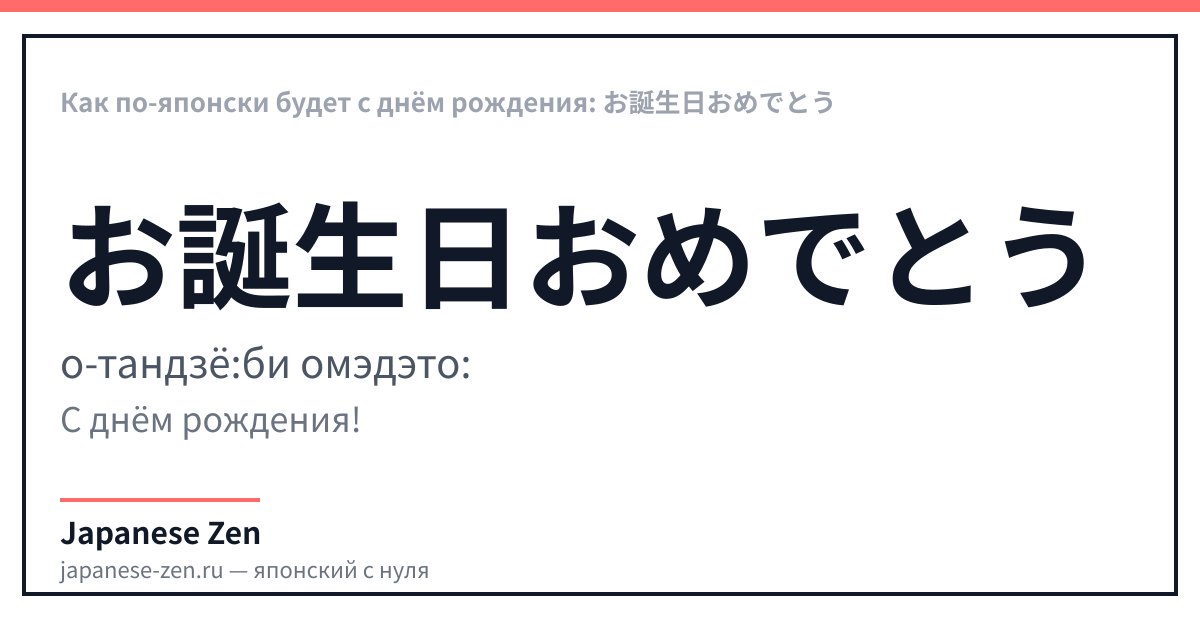
おめでとう works for any congratulation: birth, wedding, admission, win. So “happy birthday” is built simply — take the occasion and add the universal “congratulations”.
How to say happy birthday
| Japanese | Reading | Translation |
|---|---|---|
| お誕生日おめでとう | o-tanjōbi omedetō · o-tanjōbi omedetō | Happy birthday! |
| お誕生日おめでとうございます | o-tanjōbi omedetō gozaimasu · o-tanjōbi omedetō gozaimasu | Happy birthday (polite) |
| おめでとう | omedetō · omedetō | Congratulations! |
| 誕生日 | tanjōbi · tanjōbi | Birthday |
| 何歳ですか | nansai desu ka · nansai desu ka | How old are you? |
| 素敵な一年を | suteki na ichinen o · suteki na ichinen o | May your year be wonderful |
| プレゼント | purezento · purezento | Gift |
When the full form with ございます is needed
To a colleague, boss, teacher — お誕生日おめでとうございます. For friends and family, おめでとう is enough. Note the prefix お before 誕生日: with it the phrase sounds more polite, without it — friendly.
How birthdays are celebrated in Japan
- Cake with candles and “Happy Birthday” in English — a completely common sight: the Western tradition has fully taken root.
- Gifts are given with both hands and a slight bow; unwrapping in front of the giver is not necessary.
- Age is asked more casually than in Europe, but still carefully with women over twenty.
- Special dates: 20 years — 成人式 (seijinshiki), coming-of-age ceremony, and 60 years — 還暦 (kanreki), when the birth year returns in the cycle.
- At work, congratulations are modest: a card from the department, no office party.
Say the congratulation out loud
“Omedetō” — the long “o” at the end is held twice as long.
FAQ
- How do you say “happy birthday” in Japanese?
- お誕生日おめでとう (o-tanjōbi omedetō). Politely — with ございます added, short between friends — just おめでとう.
- What does “omedetō” mean?
- “Congratulations” — a universal formula for any occasion: birthday, wedding, admission, victory. The occasion is added in front.
- When to add “gozaimasu”?
- With elders, colleagues, teachers, clients. For friends and family, おめでとう without the polite ending is enough.
- How to write a congratulation in a message?
- 誕生日おめでとう🎂 — that's enough. You can add 素敵な一年を (suteki na ichinen o) — “may your year be wonderful”.
Updated: 2026-07-25