Yukata — types and varieties
Yukata is a summer cotton kimono without an underlayer. Types differ mainly by fabric and occasion: casual with a small pattern, festival — brighter with a wide obi belt, and ryokan hotel yukata is almost always plain blue with the establishment's crest. The cut is the same.
Yukata seems like one thing for all occasions. In reality, it is recognized by context before cut: hotel and festival yukata cannot be confused even from afar.
What is yukata
Yukata is a summer cotton version of kimono: without the juban undergarment, worn directly on the skin, with a soft belt simpler than the formal one. Types differ not in cut — it is the same for all — but in fabric, pattern, and occasion: what is worn to a festival would never be worn in a ryokan.
- Festival — bright pattern on a dark background, often with a complex obi belt; worn at hanabi and matsuri.
- Hotel (ryokan) — almost always plain, blue or with a small stripe, with the hotel's crest; given at the entrance as a bathrobe.
- Casual — muted colors, small pattern, minimal accessories; worn at home or for a short walk.
When it is worn today
Today, yukata is most often worn for a specific event — a summer festival or a visit to an onsen — rather than as everyday clothing. Rental shops in tourist areas dress you in 15–20 minutes, including shoes and hairstyle.
Name and kanji: 浴衣
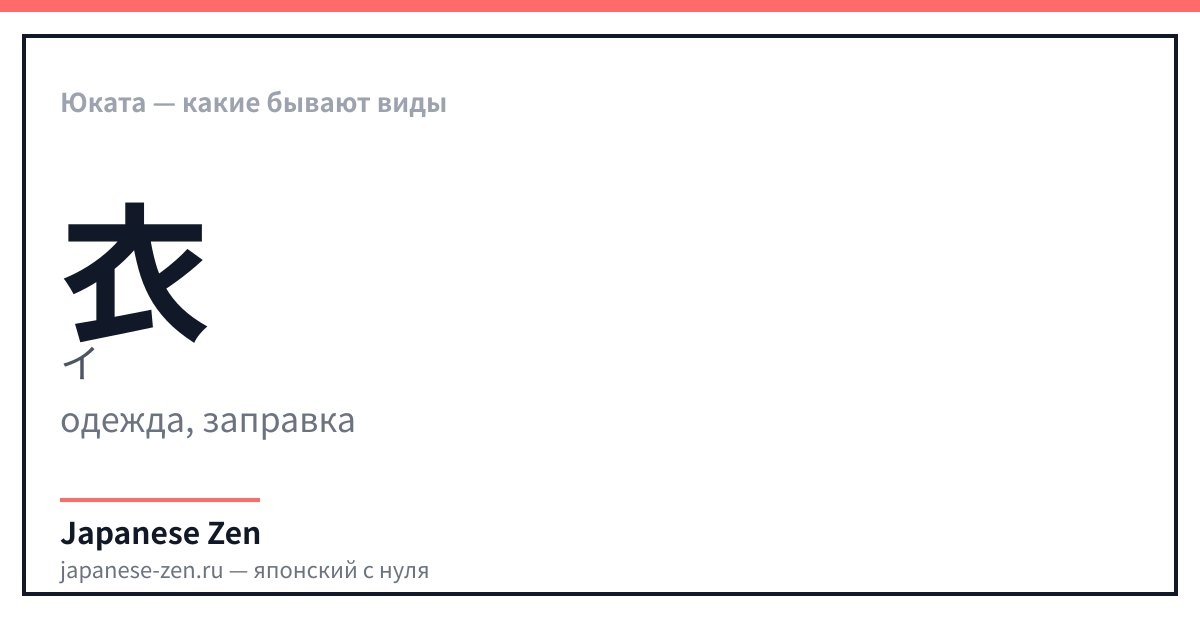
衣 — значение: clothing, wrapping — онъёми: イ、エ — кунъёми: ころも、きぬ、-ぎ — 6 штрих(ов). 衣 — 'clothing': the second character in 浴衣, the same root in 衣服 'clothing, dress' in general. The first character 浴 adds 'after bathing' — in the past, yukata was indeed worn right after the bath.
| Japanese | Reading | Translation |
|---|---|---|
| 浴衣 | yukata · yukata | Yukata |
| 帯 | obi · obi | Belt |
| 木綿 | momen · momen | Cotton |
| 下駄 | geta · geta | Wooden sandals |
| 縁日 | ennichi · ennichi | Festival day at a shrine |
浴衣 — clothing after bathing
浴衣 is read 'yukata' and is composed of 浴びる 'to bathe, to pour water over oneself' and 衣 'clothing' — 'clothing after bathing'. The occasion has expanded today to any summer, but the word itself remains tied to the bath.
Repeat the stroke order of the character 衣 in the trainer — the second symbol of the word 浴衣.
Yukata in anime and dramas
- A summer festival episode in almost every school anime — characters in yukata, fireworks in the background, food stalls.
- Bathhouse workers in 'Spirited Away' — in yukata-like robes as part of the work uniform, not festive attire.
- Hotel scene at an onsen — characters in identical striped yukata from the hotel, not their own clothes.
- Romantic scene at a festival — yukata often appears for the first time in the story when the heroine looks 'grown-up'.
Festival and hotel yukata
Yukata is confused with kimono due to the similar cut, but festival and hotel yukata are even more often confused with each other. The difference is only in the occasion: what is festive at a matsuri looks simply like a bathrobe in the corridor of a ryokan.
FAQ
- What is yukata?
- A summer cotton version of kimono without an underlayer, worn directly on the skin, with a soft belt simpler than the formal obi. The cut is the same; differences are in fabric, pattern, and occasion.
- How is yukata different from kimono?
- Kimono is made of silk and worn with a juban underlayer for any season; yukata is only cotton and only for summer. A detailed comparison is in the separate analysis 'kimono and yukata'.
- What types of yukata are there?
- Three main ones: festival — bright, with a wide obi belt; hotel — plain, with the ryokan's crest; casual — muted colors and minimal details.
- How is 'yukata' written in Japanese?
- It is written 浴衣, read 'yukata': 浴びる 'to bathe, to pour water over oneself' plus 衣 'clothing' — literally 'clothing after bathing'. In the past, it was indeed worn right after the bath; now it is worn for any summer outing.
- Is yukata worn today?
- Yes, but more often for a specific occasion — a summer festival or an onsen — rather than as everyday clothing. Rental shops dress tourists in 15–20 minutes.
- How does the men's version differ from the women's?
- Men's yukata is usually plainer and without a complex obi belt — just a simple knot. Women's is brighter, with a wider belt and a variety of hairstyles to match.
Sources
Updated: 2026-08-24