How is a kimono different from a haori
A kimono differs from a haori in purpose: a kimono is a closed robe with a wrap front and an obi belt, while a haori is a short open jacket worn over a kimono for warmth or status. A haori has no wrap front or mandatory belt—it is held closed by a pair of himo cords at the chest.
A haori looks like a short kimono, but it is not a garment in its own right—it is an outer layer: take it off and underneath is an ordinary everyday kimono, not underwear.
Kimono or haori: the short answer
The difference is essentially one: a kimono is what you wear on your body, a haori is what you wear over it. A kimono is always wrapped and belted, while a haori can be left open and worn like a jacket.
| Feature | Kimono | Haori |
|---|---|---|
| Length | To the ankle | To the hip or knee |
| Wrap front | Yes, left over right | No—worn open or tied with cords |
| Belt | Obi is required | Not needed—held with himo |
| Role | Main garment | Outer layer over a kimono |
| Who wears it | Men and women | Originally men, later everyone |
The length test
If the garment is shorter than the knee and not wrapped, it is a haori. Long, to the ankle, and belted—that is a kimono. The length test works faster than examining the pattern.
Length, wrap front, occasion
- Length: a kimono reaches the ankle, a haori reaches the hip or just below the knee.
- Wrap front: a kimono always has one, with the left side over the right; a haori's fronts simply meet or remain open.
- Belt: a kimono is held by an obi, a haori by a pair of silk himo cords at the chest.
- Purpose: a kimono is worn as a standalone garment, a haori only over other clothing, for warmth or status.
Straight panels and kamon
Both are sewn from straight panels without darts, and both can be decorated with a family crest (kamon). The lining of a haori is often more ornate than the outside—this hid the most expensive part of the pattern: modesty was valued on the outside.
Their Japanese names: 着物 and 羽織
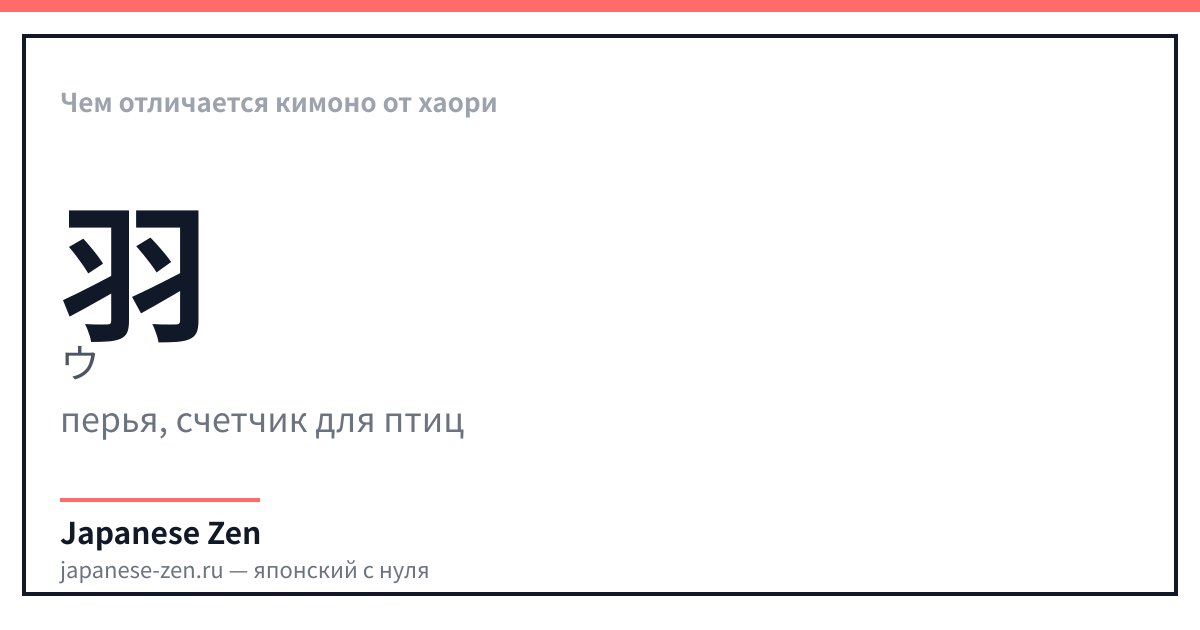
羽 — значение: feathers, counter for birds — онъёми: ウ — кунъёми: は、わ、はね — 6 штрих(ов). 羽 — “feather, wing”: the first character in 羽織. This was the name for a light jacket that opens as you move, like a bird's plumage.
| Japanese | Reading | Translation |
|---|---|---|
| 着物 | kimono · kimono | Kimono |
| 羽織 | haori · haori | Short jacket |
| 帯 | obi · obi | Kimono belt |
| 紐 | himo · himo | Cord, string |
| 袖 | sode · sode | Sleeve |
羽織 — woven plumage
羽織 is composed of 羽 “feather” and 織る “to weave”—literally something like “woven plumage.” The verb 羽織る specifically means “to throw on a haori” and is not used for any other garment.
Practice the stroke order of 羽 in the trainer—the first character of the word 羽織.
How to spot a haori on screen
- If the garment is worn open and the fronts fly apart when running—that is a haori, not a kimono.
- In “Demon Slayer,” each character’s distinctive pattern is on the haori, not on the kimono underneath.
- A samurai in a historical drama wearing a kimono and hakama is almost always also wearing a haori—it is part of the formal outfit.
- A kimono without an outer layer on screen usually indicates a domestic, informal scene.
Haori is not a jacket
The haori is often mistaken for a jacket because of its straight cut, but it is not a separate garment—it is an addition to a kimono. Historically, a haori was never worn without a kimono underneath—except today as a stylization over ordinary clothes.
FAQ
- What is the difference between a kimono and a haori?
- A kimono is a closed garment with a wrap front and a mandatory obi belt, while a haori is a short open jacket without a belt, worn over a kimono. A haori is a layer, not a separate garment.
- Can you wear a haori without a kimono?
- Today, yes—as a light jacket over jeans or a dress, that is a stylization. Historically, a haori was always a second layer over a full kimono and was not worn on its own.
- What is the main difference between a kimono and a haori?
- A kimono is the main garment with a wrap front and an obi, while a haori is an outer layer without a belt, held by a pair of himo cords. The easiest way to tell is by length: a haori is almost half the length of a kimono.
- What do a kimono and a haori have in common?
- Both are sewn from straight panels without darts and can be decorated with a family crest (kamon). The lining of a haori is often more ornate than the outside—this hid the most expensive part of the pattern from view.
- What do 着物 and 羽織 mean?
- 着物 (kimono) means “thing to wear.” 羽織 (haori) means “woven plumage,” from 羽 “feather” and 織る “to weave”: a jacket that opens as you move.
- Which appears more often in anime?
- The haori is more noticeable and more often becomes a character detail: in “Demon Slayer,” the pattern on it is each character’s personal mark. A kimono without a haori usually indicates a domestic, non-ceremonial scene.
Sources
Updated: 2026-08-24