What a Kimono Looks Like
A kimono has a straight T-silhouette with no darts: two identical panels are sewn into a robe, the left side is wrapped over the right, and the shape is held not by tailoring but by a wide obi belt. The length is adjusted with a fold at the waist, not a seam — so the same cut is worn by people 150 and 180 centimeters tall.
It seems that a kimono is tailored to the figure like a suit. In reality, the figure is adjusted to the kimono — with a fold at the waist, not a needle.
What a Kimono Consists Of
A kimono is a straight T-silhouette without darts: two identical straight panels are sewn into a robe, not cut to fit the body. The left side is wrapped over the right for all living people — the reverse wrap is reserved only for funeral shrouds. The shape is held not by tailoring but by the obi belt: without it, the kimono simply falls open while walking.
- Eri — collar; on a formal kimono, a layer of the white under-collar is visible.
- Sode — sleeve; its length and width indicate the wearer's age and status.
- Obi — wide belt; tied at the back in a bow or knot and holds the whole structure.
- Suso — hem; on a long kimono, excess length is taken up with the ohashori cord.
Why the Left Side Is Always on Top
The left-over-right wrap is a rule without exceptions for the living, and even tourists in rental kimonos don't mix it up: the shop will change it for you if you make a mistake. The reverse wrap, migi-mae, is reserved for funeral shrouds, so it is never worn — not once, not even for a photo.
Men's and Women's Cuts
Women's kimonos are sewn longer than the wearer's height: the excess fabric is gathered at the waist into an ohashori fold, so the hem doesn't drag on the floor. Men's kimonos are exactly the right length, have no fold, have narrower sleeves, and more subdued colors — blue, gray, brown instead of bright patterns across the whole fabric.
What Reveals Age and Status
- Long sleeves almost to the floor (furisode) — an unmarried woman.
- Short sleeves and pattern only along the hem — a married woman.
- Plain fabric without a pattern — the most formal option: strict etiquette or mourning.
- Bright pattern across the whole fabric — youth and a festive occasion.
Name and Kanji: 着物
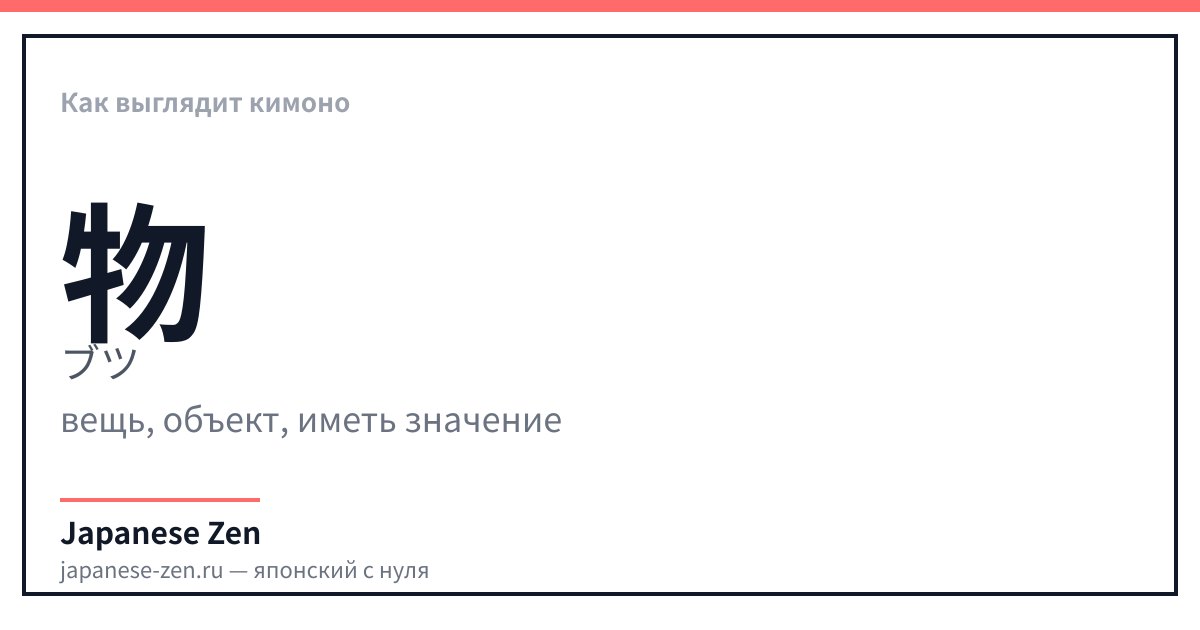
物 — значение: thing, object, to matter — онъёми: ブツ、モツ — кунъёми: もの、もの- — 8 штрих(ов). 物 — 'thing, object': the second character in 着物. The same root appears in 食べ物 'food' and 買い物 'shopping' — any tangible thing goes through this kanji.
| Japanese | Reading | Translation |
|---|---|---|
| 着物 | kimono · kimono | Kimono |
| 帯 | obi · obi | Belt |
| 袖 | sode · sode | Sleeve |
| 着る | kiru · kiru | To wear |
| 衿 | eri · eri | Collar |
着物 — a thing for wearing
着物 breaks down without a dictionary: 着る 'to wear' plus 物 'thing' — 'a thing for wearing'. The word came to mean specifically traditional clothing only in the 19th century, when European clothing appeared alongside and it became necessary to distinguish it from the familiar.
Practice the stroke order of the character 物 in the trainer — the second character of the word 着物.
Kimono in Anime and Dramas
- 'Chihayafuru' — teams compete in karuta tournaments wearing kimonos; it's part of the rules.
- A strict black kimono without a pattern on a secondary character usually reads as a sign of mourning or emphasized seriousness.
- NHK historical dramas ('taiga') — the silhouette and sleeve width show the era in which the action takes place.
- Miyazaki's 'Howl's Moving Castle' — kimonos and European clothing coexist in the same frame, and the difference in cut is striking.
What Artists Simplify
Drawn kimonos almost always lack the under-layer nagajuban, which is mandatory in real life and visible at the collar. Saving on details speeds up drawing, but this same feature makes it easy to distinguish a staged photo from a real outfit.
FAQ
- What does a kimono look like?
- A straight T-silhouette made of two panels, wrapped left over right and tied with a wide obi belt. The cut is the same for all sizes — the figure is adjusted not with a seam but with a fold at the waist.
- What parts does a kimono consist of?
- The eri collar, sode sleeve, obi belt, and suso hem — four details by which formality and the wearer's status are read. Excess fabric length on a women's kimono is hidden with the ohashori fold.
- How is a kimono different from a yukata?
- A yukata is a summer cotton version of a kimono without an under-layer, worn directly on the body. A detailed comparison of all features is in the separate breakdown 'kimono and yukata'.
- What kinds of kimonos are there?
- From the formal furisode with long sleeves to the strict tomesode — the types and their occasions are collected in a separate overview. The difference is visible in sleeve length and pattern density.
- How do you write 'kimono' in Japanese?
- The word is written 着物 and read 'kimono': 着る 'to wear' plus 物 'thing'. Literally — 'a thing for wearing', without metaphors or hidden meaning, as straightforward as the garment's cut itself.
Sources
Updated: 2026-08-24