Hikikomori — who they are and how they live
Hikikomori (引きこもり) is a person who has voluntarily withdrawn from social life and rarely leaves home for months or years. The term was coined by psychiatrist Tamaki Saito in 1998; according to Japanese government estimates, there are now over a million such people in the country, many already over forty. They usually live under their parents' care — hence the '8050 problem', when eighty-year-olds support fifty-year-old children.
Hikikomori are not idle in the usual sense: behind closed doors, most have their own day with waking up, eating, and activities — just without a single step outside.
Who is considered a hikikomori: the formal criterion
The formal criterion used by the Japanese government: a person does not leave home and has almost no contact with people outside the family for at least six consecutive months. The reasons vary — bullying at school, failing exams, losing a job, panic disorder, or simply accumulated pressure to meet expectations. Hikikomori usually live in their parents' home: the room becomes the only familiar space, and food and money are provided by the family, which often feels ashamed of the situation and hides it from neighbors.
- Official threshold: no leaving home and no social contacts for at least six months.
- Age: the phenomenon is no longer just teenage — the share of people over 40 has grown noticeably over the past two decades.
- Numbers: according to government estimates, over a million people in Japan, up to 1% of the population.
- '8050 problem': eighty-year-old parents support fifty-year-old hikikomori children — both sides age within the same isolation.
Where did so many hikikomori come from?
The term was coined by psychiatrist Tamaki Saito in the late 1990s, describing patients stuck between school and adult life. Since then, the phenomenon has not shrunk but spread across ages: those who shut themselves in their rooms as teenagers in the nineties often remain hikikomori now, just older. Individual cases are also recorded in South Korea, Italy, and France — it is not purely a Japanese phenomenon, but it is in Japan that it has been studied the longest and given its own name.
引きこもり — 'pulling inward'
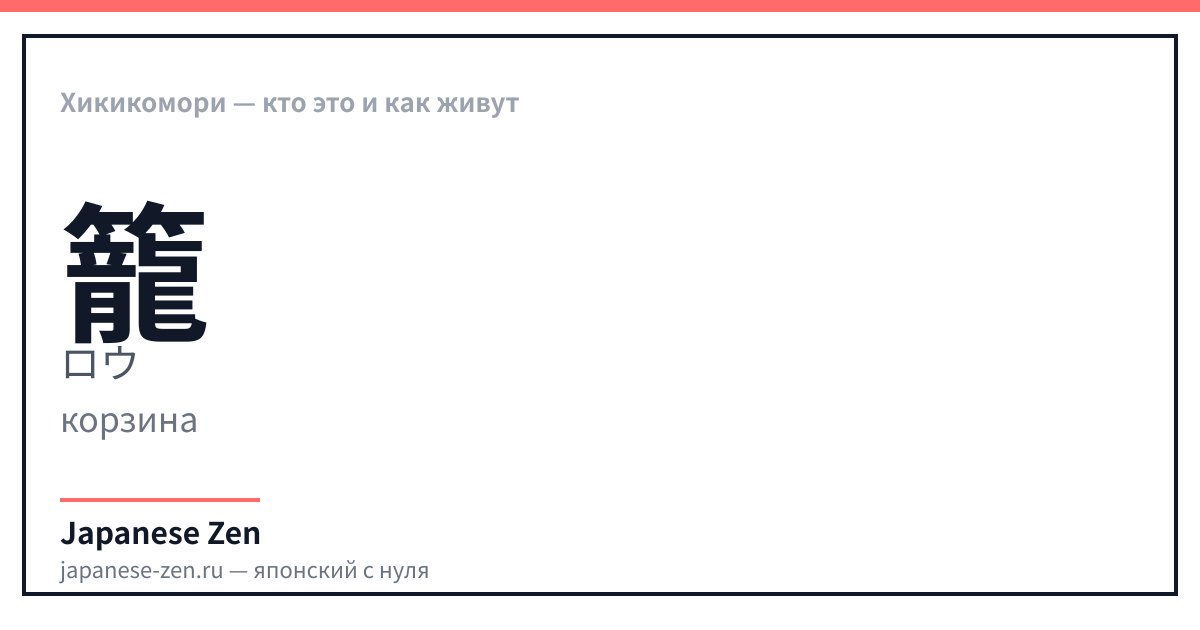
籠 — значение: basket — онъёми: ロウ、ル — кунъёми: かご、こ.める、こも.る、こ.む — 22 штрих(ов). 籠 — 'to shut oneself away, to seclude oneself': in the verb 籠る (komoru) it gives the word its second half of meaning. The first character of the word, 引く 'to pull', is not yet separately marked in the stroke order database.
| Japanese | Reading | Translation |
|---|---|---|
| 引きこもり | hikikomori · hikikomori | A person who has voluntarily withdrawn from social life |
| 引き籠る | hikikomoru · hikikomoru | To shut oneself away, to retreat into voluntary seclusion (verb from which the noun is derived) |
| 不登校 | futōkō · futōkō | Refusal to attend school (related but not identical term) |
| 8050問題 | hachi-maru go-maru mondai · hachi-maru go-maru mondai | '8050 problem' — parents aged 80 support children aged 50 |
| 社会復帰 | shakai fukki · shakai fukki | Return to society (goal of rehabilitation programs) |
What does this word mean literally?
引きこもり literally means 'pulling inward': 引く, to pull, plus こもる, to hide, to shut oneself away. The word was originally an everyday verb for any voluntary seclusion, and it was psychiatry of the late nineties that turned it into a term for a specific social phenomenon.
Listen to the word hikikomori and related terms — the app will evaluate your pronunciation.
How many are there now and who are they mostly?
Yes, and the phenomenon is not declining: government surveys in recent years show a growing number of hikikomori among people over forty, not just among teenagers as expected in the nineties. Municipalities are opening hotlines and support centers, but this rarely brings people out of their rooms quickly — most programs are designed for years of gradual return to contact, not for one-time intervention.
Hikikomori in anime and doramas
- 'Welcome to the N.H.K.' — the most direct and dark adaptation of the theme: the hero does not leave his apartment and is convinced the whole world is against him.
- 'Evangelion' and its protagonist Shinji Ikari have become a fan-standard for psychological withdrawal, although formally he is not a hikikomori in the clinical sense.
- 'Hikkimori' and individual episodes of shonen titles use the recluse image as a comedic archetype — 'a nerd who never leaves his room'.
What cinema simplifies
Screen hikikomori are most often either genius programmers or victims of a single traumatic scene — the real picture is much slower and without a single obvious cause. Most real cases have no dramatic trigger, but rather a gradual accumulation of fatigue from social demands, which cinema is poorly equipped to show in a single episode.
FAQ
- What does hikikomori mean?
- A person who has voluntarily withdrawn from social life and rarely leaves home for at least six months. The word 引きこもり literally means 'pulling inward' — from the verb 'to shut oneself away'.
- Who is called a hikikomori?
- People in voluntary social isolation, usually living under their parents' care. According to Japanese government estimates, there are over a million of them, and the share of people over forty among them is growing.
- How do hikikomori live?
- Most often in their parents' home, rarely leaving their room and not communicating outside the family. Food and expenses are provided by relatives, and the daily routine remains personal and closed to outsiders.
- How is the word 'hikikomori' written in Japanese?
- 引きこもり, read as ひきこもり. It is composed of 引く 'to pull' and こもる 'to shut oneself away, to hide'.
- Are there hikikomori now?
- Yes, and their number is growing, not shrinking: government surveys show an increase in the share of people over forty among hikikomori in recent years.
- How are hikikomori different from shōjo?
- These are terms from different fields: hikikomori refers to people in social isolation, while shōjo refers to a target audience of manga and anime. The only commonality is their Japanese origin and their path into the Russian language through pop culture.
Sources
Updated: 2026-08-28