Sensei — who is it and who is addressed this way
Sensei (先生) is a respectful address for a teacher, doctor, lawyer, master, or another person whose experience and status are recognized as clearly superior to the speaker's. Literally, the word means 'born earlier': 先 'before' plus 生 'life, birth'. In Japanese, it is added after the surname instead of the personal name, and in this sense it is closer to a respectful title than to a simple 'teacher'.
In Japanese speech, sensei is used roughly where in Russian a title like 'doctor' or 'professor' would be — not a position, but a recognition of another's superiority in a field.
Who is called sensei
The circle is wider than 'school teacher'. Sensei is used for teachers of any level, doctors and dentists, lawyers and attorneys, martial arts masters and artisans, manga authors and writers, and in politics — members of parliament. What all these professions have in common is that the speaker recognizes in the person experience or training that the speaker themselves does not have and likely never will.
- Teacher, university professor, tutor — the basic and most common usage.
- Doctor, dentist, psychotherapist — the address is almost automatic, regardless of the doctor's age.
- Lawyer, attorney, notary — recognition of professional qualification.
- Dojo master, manga author, parliament member — the status of an expert or public figure, not a diploma.
When it is inappropriate to address someone this way
For peers, colleagues of the same level, and strangers without obvious status, sensei is not suitable — here san or more neutral forms of address work. It is also incorrect to call oneself this: the word describes recognition from others, not a self-designation, and in the first person it is used only in rare ironic contexts.
先生 — 'born earlier'
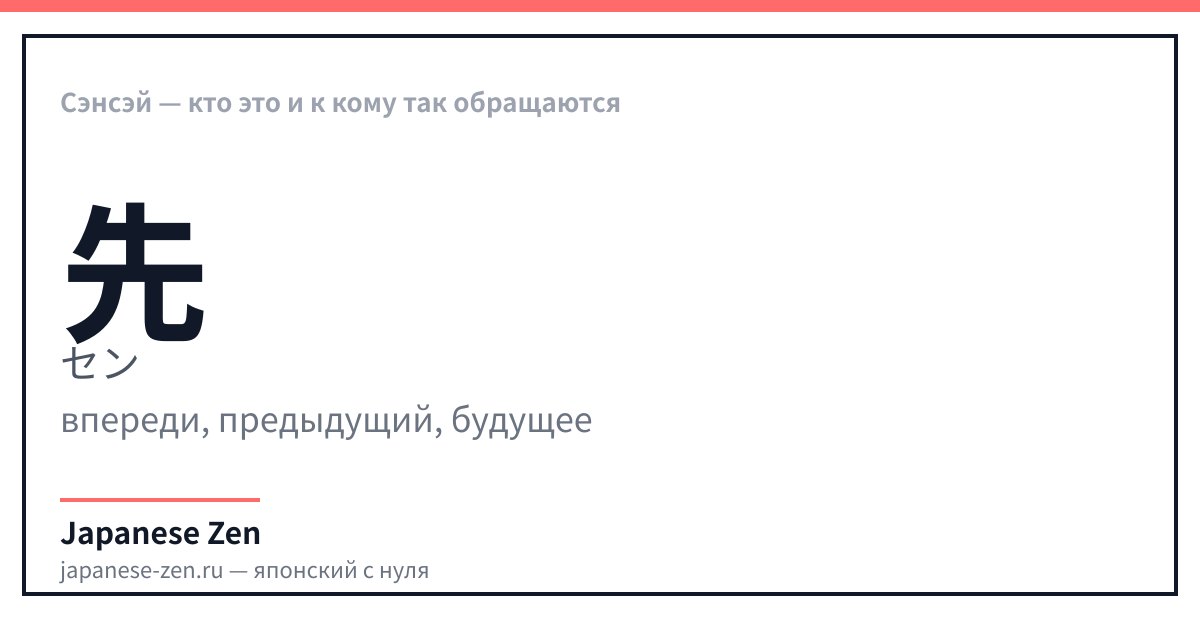
先 — значение: ahead, previous, future, priority — онъёми: セン — кунъёми: さき、ま.ず — 6 штрих(ов). 先 — 'before, ahead': the first character of the word 先生. The second, 生 'life, birth', is not yet marked with a separate card in the stroke order database.
| Japanese | Reading | Translation |
|---|---|---|
| 先生 | sensei · sensei | Teacher, doctor, master — respectful address |
| 田中先生 | Tanaka-sensei · Tanaka-sensei | 'Teacher Tanaka' — the word is added after the surname |
| 教師 | kyōshi · kyōshi | Teacher as a profession (neutral word for documents, not an address) |
| 師匠 | shishō · shishō | Mentor, master (more often about martial arts and crafts) |
| 先輩 | senpai · senpai | Senior comrade (the same character 先 'before', but without the 'teacher' status) |
How the writing 先生 is broken down
先生 is read せんせい, sensei: 先 — 'before, earlier', 生 — 'life, birth'. Literally — 'born earlier', that is, one who came into the field or life before you and managed to accumulate experience. The word is placed after the surname instead of the personal name: Tanaka-sensei, not Tanaka-san — a replacement, not an addition to the usual address.
Listen to the word sensei and related terms — the app will evaluate your pronunciation.
Is the address still used today
Yes, and without signs of becoming outdated: in modern Japan, sensei remains the standard address in schools, hospitals, law offices, and dojos. Outside Japan, the word is most often kept untranslated precisely in the context of martial arts — historically, foreign students called karate, judo, and aikido teachers this way, and it has become established in the international sports lexicon separately from everyday Japanese usage.
Sensei in anime and doramas
- Teacher-mentors in school anime — from strict homeroom teachers to eccentric martial arts coaches — almost always the address 'sensei' is heard from the very first meeting scene.
- 'Naruto' is built on a pair of sensei-student: Kakashi-sensei and his team are an example of how the address fixes hierarchy without a formal lesson.
- In stories about manga artists and writers, 'sensei' is used for the author — editors and assistants address them this way, not just readers.
What is exaggerated in this image
Anime often turns sensei into a figure surrounded by almost religious reverence, whereas in real life the address remains workaday and quite mundane — like 'doctor' at an appointment. Dramatization is needed for the plot: the conflict between student and mentor works better if the mentor is shown in advance as an almost infallible authority.
FAQ
- Who are sensei?
- Teachers, doctors, lawyers, martial arts masters, manga authors, and parliament members — all those whose experience or status the speaker recognizes as clearly superior to their own. Sensei is not a profession, but a form of address.
- How is sensei written?
- 先生, read せんせい. 先 means 'before, earlier', 生 — 'life, birth'; together — 'born earlier', that is, one who has surpassed you in experience.
- Who is addressed as 'sensei'?
- Teachers and professors, doctors, lawyers, dojo and workshop masters, manga authors, parliament members. The word is added after the surname instead of the personal name.
- Is sensei a profession?
- No, it is a form of address, not a position. The same person may be a doctor, lawyer, or master by profession — what makes them a sensei is the recognition of status by the interlocutor, not an entry in a work record book.
- Can you call yourself sensei?
- Usually no: the word describes respect from others, not a self-designation. Calling yourself that out loud almost always sounds immodest or ironic, not as a neutral fact.
Sources
Updated: 2026-08-29